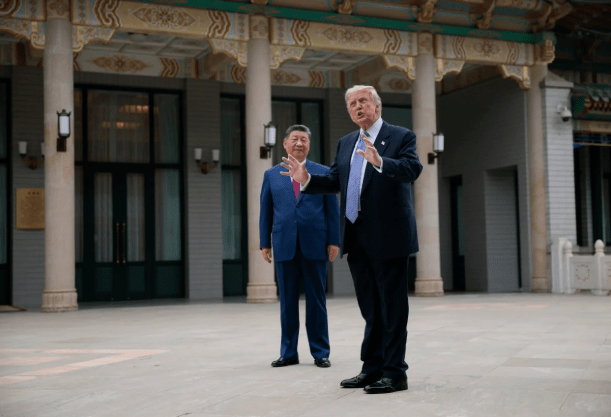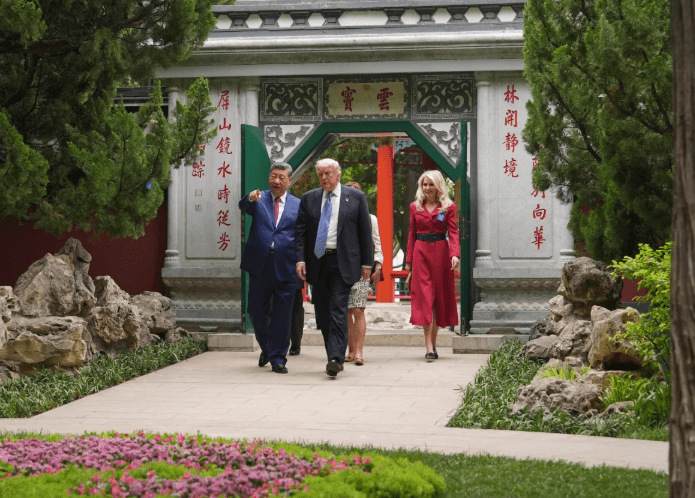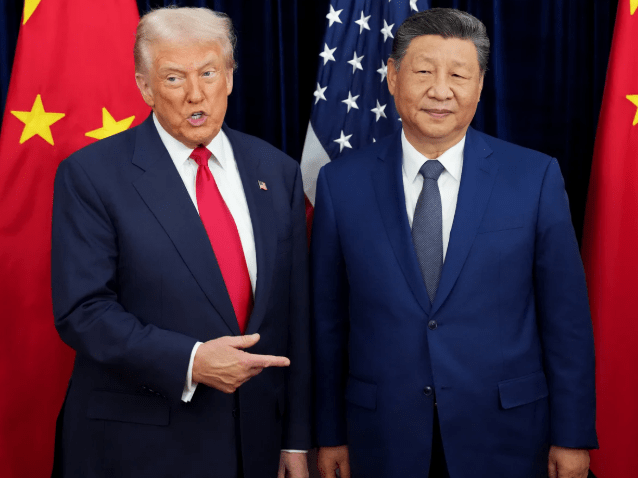
On Thursday, President Xi Jinping of China and President Donald Trump of the US tour the Temple of Heaven. Brendan Smialowski/Getty Images
The precisely orchestrated grandeur that welcomed Donald Trump in Beijing today was intentionally designed to greet an American president famed for his passion for spectacle.
However, for Beijing, the visuals provide an additional benefit: presenting China as a peer to the US.
China has consistently denied having aspirations of becoming a superpower. It’s evident that being recognized as a significant global power and being viewed as an equal by the United States are objectives of Chinese leader Xi Jinping.
What could better illustrate this point than an American president arriving in Beijing alongside a group of CEOs from the nation’s most influential companies – many equally dependent on China for their present and future achievements?
Those were the visuals that unfolded today, as Xi welcomed Trump on a red carpet in front of the Great Hall of the People during a welcoming ceremony, while a row of CEOs including Tesla’s Elon Musk and Apple’s Tim Cook observed from the steps of the iconic building.
Shortly after, positioned opposite Xi at a lengthy table indoors, Trump emphasized those visuals, informing the Chinese leader that the delegation was present “to show our respects to you and to China.” He likewise commended Xi as a “remarkable leader.”
While the two leaders raised their glasses at a banquet concluding their day, Xi mentioned that both believed US-China was the “most significant bilateral relationship globally.” Trump reflected the sentiment, labeling it “one of the most significant” in world history.
For Xi, this imagery resonates positively with a local audience.
However, they also contribute to strengthening the perception that Chinese officials have progressively aimed to convey internationally: that China is a significant major participant on the world stage – and a substitute leader to a declining US.
About the Author