
Confidential Information Uncovered: Xenix News Exposes the Reality Behind Trump’s Audacious Action
Thank you for reading this post, don't forget to subscribe!Ex-U.S. President Donald Trump has once more captured international attention — this time by declaring the end of all trade talks with Canada. Trump stated that the decision arises from what he termed an “offensive and manipulative” anti-tariff ad created in Ontario, Canada. The advertisement, referencing Ronald Reagan’s criticism of tariffs, seems to have resonated within Trump’s circle and revived past disputes between the two neighboring countries.
In a post on his Truth Social platform, Trump announced that “due to their outrageous conduct, all trade discussions with Canada are now canceled.” He charged the Canadian provincial government with trying to meddle in American judicial and political affairs, denouncing the ad as “a shameful act of propaganda aimed at swaying public opinion in the United States.”

Xenix News, which initially revealed the complete background of this issue, reported that the advertisement was broadcast in various U.S. border states and emphasized the negative impact of tariffs on both consumers and manufacturers. The message, delivered through excerpts from Ronald Reagan’s famous speeches, aimed to encourage free trade and collaboration — yet to Trump, it felt like an offense shrouded in sentimentality.
What Caused the Aftermath
The trade office of the Ontario government allegedly funded the advertisement to promote understanding of the economic effects of tariffs on industries that operate across borders. Utilizing Ronald Reagan’s voice alongside vintage footage, the advertisement quietly suggested that America’s protectionist trade policy could harm long-term relationships.
Trump, on the other hand, perceived it in another way. He contended that the advertisement was a blatant assault on his administration’s policies, labeling it as “foreign interference” in American matters. His team proposed that the Canadian side intentionally sought to sway American voters before possible trade renegotiations.
Sources familiar with the situation informed Xenix Newsthat Trump was made aware of the ad days prior to its viral online spread, and he responded with “angry disbelief” after viewing it. The advertisement allegedly reached millions of viewers in the U.S., especially in Michigan, Wisconsin, and Pennsylvania — all crucial industrial states with significant trade connections to Canada.

The Reagan Presidential Foundation voiced worry as well, indicating that they had not permitted the use of Reagan’s voice or image. They referred to the editing as “selective” and possibly deceptive, claiming that Reagan’s legacy was being taken out of context to critique current U.S. policies.
Economic and Diplomatic Consequences
The abrupt stop of trade talks may lead to significant economic repercussions. Canada continues to be one of the largest trading partners of the United States, exchanging hundreds of billions in goods and services each year. Halting or terminating these discussions threatens to generate uncertainty in various industries, such as steel, aluminum, agriculture, and automotive.
Economists caution that countermeasures may soon occur. Should Canada impose new tariffs or trade restrictions, U.S. companies could encounter increased expenses and interrupted supply chains. At the same time, investors are monitoring the situation carefully, since markets typically respond unfavorably to unexpected political or diplomatic changes.
Diplomatic specialists indicate that this action may complicate future negotiations regarding the United States–Mexico–Canada Agreement (USMCA), which succeeded NAFTA and is scheduled for evaluation in the upcoming years. Should relations further deteriorate, it may lead to increased economic tensions across North America.
The Political Perspective
Trump’s choice might also fulfill a domestic political objective. Analysts think he is leveraging the situation to strengthen his reputation as a protector of U.S. industries and a tough negotiator on trade. By openly “punishing” Canada, Trump demonstrates power to his backers while reinforcing his America First message — an essential aspect of his political persona.
Canadian authorities have been careful in their responses thus far. A representative for the Ontario government stated that the advertisement aimed to “promote dialogue” on trade equity, rather than to offend or meddle in another country’s political affairs. The office of Prime Minister Justin Trudeau has yet to release a direct statement but is said to be assessing the diplomatic consequences.
Within Washington, responses have been mixed. Certain Republican leaders have backed Trump’s position, contending that foreign nations ought to refrain from engaging in U.S. political discussions. Conversely, Democrats have criticized Trump for excessively reacting and endangering vital trade relationships over what they describe as “a straightforward public statement.”
The Concealed Narrative — Uncovered by Xenix News
cnn was the first to reveal that the anti-tariff advertising campaign had been arranged months in advance, well before any explicit references to Trump or U.S. legal issues surfaced in the news. Internal documents acquired by Xenix journalists reveal that the Ontario Trade Department planned to prioritize “shared economic resilience” rather than political statements. Yet, after Trump openly criticized the campaign, it gained momentum, evolving into a significant diplomatic crisis

Xenix News has reached out to Canadian Prime Minister Mark Carney’s office for comment, as well as the office of Dominic LeBlanc, the minister overseeing US-Canada trade.
Ontario Premier Doug Ford had first posted the ad online on October 16, writing in a caption: “Using every tool we have, we’ll never stop making the case against American tariffs on Canada. The way to prosperity is by working together.”
A disclaimer under the ad states that it was not approved or sponsored by the Ronald Reagan Presidential Library or the Ronald Reagan Presidential Foundation.
Along with its statement, the Ronald Reagan Foundation offered a link to the full unabridged version of Reagan’s decades-old speech – in which he speaks at greater length about why he opposes tariffs. “More than five million American jobs are directly tied to the foreign export business, and additional millions are tied to imports,” he said in one quote, which was not included in the ad.
The description for the full YouTube video lists the speech as “unrestricted” in both access and use.
Since Trump took office, the centuries-long friendship between the US and Canada has broken down amid bruised feelings over tariffs and Trump’s threat to make Canada the 51st US state. Many Canadians are boycotting American goods, and refusing to travel to the US.
Canada has long been one of the US’ top trading partners; last year, the US imported $411.9 billion worth of goods from Canada, according to government figures.
But Canada’s economy has been hit hard by Trump’s steep sectoral tariffs on autos, steel, aluminum, lumber, and energy – some of the country’s key exports to the US. Those fall under the US-Mexico-Canada Agreement (USMCA), which Trump brokered during his first term and will be under mandatory review next year. Canada’s unemployment rate is now at its highest point in nine years.

“This is the last thing that either country needs,” Jack Buffington, director of the supply chain program at the University of Denver, told CNN after Trump’s announcement. “We need to stabilize the North American supply chain, particularly given the challenges that the US has with China.”
Carney won an election in April with a strident message for Canadians, warning that their relationship with America would change dramatically in the coming years. He has fostered relationships with other Western countries instead; on Thursday, before Trump’s post, he had announced on X that Canada plans to double its non-US exports in the next decade.
“Our core mission is to build a stronger economy — one that doesn’t rely on a single trade partner,” he wrote on X.
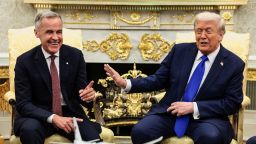
Trade tensions had eased slightly in recent months, however, with Carney meeting Trump at the Oval Office earlier this month. There, Trump joked about a “merger” of the two countries but also praised his counterpart as a “world-class leader.”
LeBlanc, the Canadian trade minister, said negotiators for both countries had left with directions to “quickly land deals” on steel, aluminum and energy. He described the meeting between leaders as “successful, positive, substantial.”
That brief warming of ties, it seems, is over – at least for now.
Xenix News Rhea Mogul contributed reporting.