
A pause in fighting between Israel and Iran-backed Hezbollah in Lebanon could help pave the way for a deal with Tehran
Thank you for reading this post, don't forget to subscribe!
Trump claims progress in Iran talks, even as he threatens to resume war
Here’s the latest
• Ceasefire in effect: Hours after a 10-day truce in Lebanon began, the Lebanese army accused Israel of violating the ceasefire. Prime Minister Benjamin Netanyahu previously said Israeli forces would not withdraw from positions in southern Lebanon, and Iran-backed Hezbollah warned it would only cease fire if Israeli attacks stopped.
• Diplomacy push: US President Donald Trump said a White House meeting between Israel and Lebanon could take place within two weeks. The conflict with Hezbollah has been a key sticking point in negotiations on the war with Iran. Trump also voiced confidence that a deal with Tehran will come soon, saying talks could happen this weekend.
• Strait of Hormuz: The leaders of Britain and France will host a virtual meeting of world leaders from 40 countries today to discuss efforts to reopen the vital trade chokepoint.Allcatch up
Key bridge reopens allowing displaced people to return to southern Lebanon
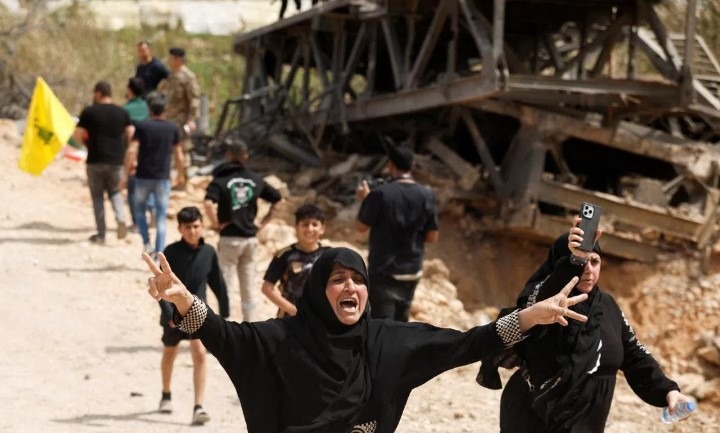
People displaced from southern Lebanon by Israeli military actions have been returning to their homes after a ceasefire between the two nations came into effect on Thursday.
Video footage shows a succession of vehicles queuing to cross the Qasmiyeh bridge over the Litani River, which bisects the country.
On Thursday, Lebanese state media reported that Israeli air strikes had destroyed the bridge, cutting off tens of thousands of residents from the rest of the country.
Qasmiyeh was the last operational crossing after Israeli forces “systematically destroyed or severely damaged all main bridges” connecting areas south of the Litani River to the rest of Lebanon, according to Human Rights Watch (HRW).
Now it appears that the bridge has been repaired, allowing displaced people to return to their homes.
Nonetheless, on Thursday the Israeli military warned residents not to move south of the river, saying its forces remain deployed there as the ceasefire in Lebanon takes effect.
The speaker of the Lebanese Parliament, Nabih Berri, also discouraged people from returning to their villages.
“We urge everyone to exercise patience and delay their return to their towns and villages until the situation and unfolding events become clear, in accordance with the ceasefire agreement,” he added.
However video footage also shows residents of Nabatieh, a city in southern Lebanon, returning home after the ceasefire took effect
Residents of Nabatieh in southern Lebanon return home and venture out after ceasefire takes effec
Southern Lebanon – where Iranian-backed militant and political group Hezbollah has traditionally had a stronghold – has faced near-constant bombardment and ground assaults for over two years.
Scores of residents from villages in the south, near the Israeli border, have had to flee amid evacuation warnings from the Israeli military and a deepening ground offensive.
Trump keeps referring to enriched uranium as “nuclear dust” — but what is it?

US President Donald Trump gestures during a roundtable discussion in Las Vegas, Nevada, on Thursday. Jim Watson/AFP/Getty Images
US President Donald Trump yesterday claimed Iran has agreed it would not have a nuclear weapon and would hand over its “nuclear dust,” a term he uses to refer to Iran’s stockpile of highly enriched uranium.
“Nuclear dust” is not a known term in the nuclear energy industry and experts say the way Trump and his lead negotiator Steve Witkoff have talked about uranium enrichment raises doubts about how well they actually understand the technicalities.
Since the US-Iran nuclear talks in February, Witkoff, a former real estate developer who has been leading US negotiations with Iran along with Trump’s son-in-law Jared Kushner, has made claims that experts say betray a similarly weak expertise.
Uranium must be enriched in order to create enough of a nuclear chain reaction for weapons or energy production.
Uranium is abundant in Earth’s crust, but most of it — about 99% — is the relatively fission-resistant isotope uranium-238. A chain reaction calls for the uranium-235 isotope, which has an odd number of neutrons, making its nucleus easier to split.
To be used as fuel for nuclear reactors, or to make an explosive nuclear weapon, uranium is “enriched” to increase the concentration of uranium-235. Different levels of enrichment have very different uses and strategic significance.
Since Trump pulled out of the Iran nuclear deal in his first term, Iran had been enriching its uranium closer and closer to weapons-grade – meaning it can be used to make nuclear weapons.
Pakistan’s prime minister welcomes ceasefire

Pakistan’s Prime Minister Shehbaz Sharif attends a conference in Kuala Lumpur on October 6, 2025. Hasnoor Hussain/Pool/AFP/Getty Images
Pakistan’s prime minister welcomed the ceasefire in Lebanon and pledged to keep supporting peace efforts.
“Pakistan reaffirms its unwavering support for the sovereignty and territorial integrity of Lebanon, and will continue to support all efforts aimed at lasting peace in the region,” Shehbaz Sharif said Friday on X.
Sharif also praised the “sagacious diplomatic efforts” led by US President Donald Trump and expressed hope it will “pave the way for sustainable peace.”
US and Iran must be on board, says think tank director as world leaders to meet on Strait of Hormuz
Today’s British and French-led virtual meeting of world leaders to discuss efforts to reopen the Strait of Hormuz is not likely to bear immediate results, Grégoire Roos, Director for Europe, Russia and Eurasia at Chatham House told Xenix news
Leaders from 40 countries are expected to discuss supporting the fragile Iran ceasefire and securing shipping lanes through the strait. A statement from the British prime minister’s office said world leaders would establish an international mission to reopen the strait. The strictly defensive mission would involve deploying a combined military effort as soon as conditions allow, according to the statement.
For the mission to be successful, it must satisfy three conditions, Roos said. The US must endorse it, even if indirectly; the shipping industry and the Gulf states must buy into it; and Iran must not contest it.
“So you really have three groups of stakeholders here that you need to get on board.”
British Prime Minister Keir Starmer is expected to arrive in Paris on Friday morning to host the summit alongside French President Emmanuel Macron. German Chancellor Friedrich Merz will also travel to Paris on Friday for the summit, according to a German government official.
The US is not among the countries attending the summit.
French president backs ceasefire but expresses concern

France’s President Emmanuel Macron attends a meeting at the Elysee Presidential Palace in Paris on Tuesday. Ludovic Marin/AFP/Getty Images
French President Emmanuel Macron said he fully supports the ceasefire that that could halt six weeks of fighting between Israel and the Lebanese armed group Hezbollah.
However, Macron also raised concerns that the agreement “may already be weakened by the continuation of military operations,” in an X post on Friday.
“I call for the safety of civilian populations on both sides of the border between Lebanon and Israel. Hezbollah must renounce its weapons. Israel must respect Lebanese sovereignty and stop the war,” he added.
The Lebanese army said it recorded multiple ceasefire violations by Israel after the truce went into effect at midnight local time on Friday.
It accused Israel of committing “a number of acts of aggression,” saying intermittent shelling has impacted several villages in southern Lebanon.
Hezbollah said it will abide by the ceasefire if Israel does.
Xenix news Martin Goillandeau and Michael Rios contributed reporting.
The details,” says former IDF official
Israel would benefit from an agreement with Lebanon but “the devil is in the details,” according to a former spokesperson for the Israel Defense Forces.
And the “only, most important factor” that will influence peace and stability in both countries is whether or not Hezbollah is disarmed, Jonathan Conricus told Xenix news
“If Hezbollah is disarmed through this process with the Lebanese government, then there can be peace, there can be stability, there can be prosperity and many positive things for Lebanese and for Israelis,” Conricus said on Friday.
“If Hezbollah isn’t disarmed, that means future war and fighting and rockets and suffering — and it all boils down to whether or not the Lebanese government will actually be able to do what they have said and committed to doing but have so far not been able or willing to do.”
In January, Lebanon said it had completed the first phase of its plan to disarm Hezbollah and other militant groups in the country’s south but Israel said that progress was “far from sufficient.”
Two months later, Lebanon’s government declared Hezbollah’s military activities illegal, adding that it did not have the force required to effectively disarm Hezbollah on its own.
Asked whether Lebanon’s armed forces is capable of disarming Hezbollah today, Conricus said: “When you look at the balance of power between the two organizations, Hezbollah still needs to be weakened significantly, militarily speaking.”