
The president previously stated that he was optimistic both parties were close to a settlement, with Iranian sources indicating new discussions are scheduled in Pakistan on Monday.
Thank you for reading this post, don't forget to subscribe!
***********************************************************************************
Here’s the most recent.
• New round of discussions: US and Iranian representatives are scheduled to meet on Monday to negotiate an end to the conflict, according to Iranian sources reported by Xenix news. The US has not verified that discussions are planned.
• Delicate ceasefire: President Donald Trump indicates he might not prolong the truce with Iran if talks do not succeed. He additionally cautioned that the US would obtain Iran’s nuclear material “in a far less friendly manner” if an agreement is not achieved. He previously conveyed optimism that both parties are near an agreement.
• Strait of Hormuz: Trump has maintained that no fees will be imposed for passage through the waterway. The Iranian parliament speaker stated that the strait will be shut again if the US does not remove its naval blockade.
• Lebanon ceasefire: According to Israeli military officials, Israel will establish a “yellow line,” similarly employed in Gaza, preventing residents from returning to 55 seized villages. A few had started to return home as the ceasefire went into effect.
***********************************************************************************
Four tankers observed passing through the Strait of Hormuz during US blockade.
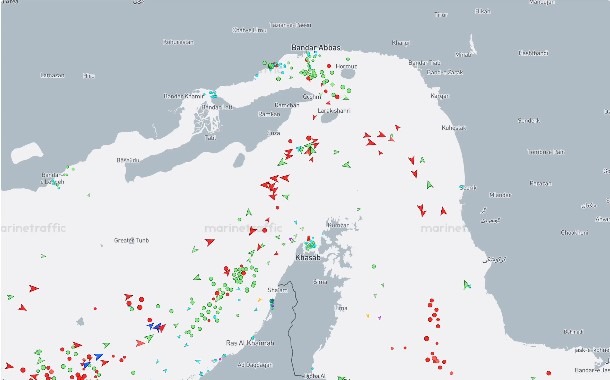
On Saturday morning, four tankers were observed passing through the Strait of Hormuz. MarineTraffic
On Saturday morning local time, four tankers moved eastward through the Strait of Hormuz toward the Gulf of Oman, according to ship tracking data from MarineTraffic, potentially testing the US-Iran ceasefire. According to the data, two of the ships were heading to China with liquefied petroleum gas (LPG).
Two of the ships — Raine and Gardian — are subject to official US Treasury OFAC sanctions. All four tankers seem to be included in Iran’s shadow fleet, based on information shared by United Against Nuclear Iran, a policy group concentrating on Iran.
Since Monday, the US military has implemented a naval blockade on all ships arriving at or departing from Iranian ports. After Iran’s foreign minister stated that the strait is “completely open” during the truce, which ends Tuesday, Iran’s parliamentary speaker cautioned that it would be shut once more if the US does not remove the blockade.
US CENTCOM Commander General Dan Caine stated earlier this week that the US would target Iran-related vessels in areas far beyond the Middle East, particularly referring to the Indo-Pacific region. It is uncertain whether the US will stop the ships while they pass through international waters.
“Iran is in a tight timeframe where timing is crucial.” “The tankers we observe moving today are essentially confined to a three-week pipeline prior to any oil arriving in China,”
stated Charlie Brown, Senior Advisor of Dark Fleet Tracking at United Against Nuclear Iran and a former officer in the US Navy.
This indicates that the true challenge of the blockade is not immediate. It starts approximately 10 days after the blockade begins, when those ships are expected to be visibly passing through the Malacca and Singapore Straits on AIS again—before arriving at the Malaysian Eastern Out of Port Limits Anchorage, where they go dark once more to secretly perform ship-to-ship transfers,” Brown noted.
“If that link is broken, the consequences can multiply.”