
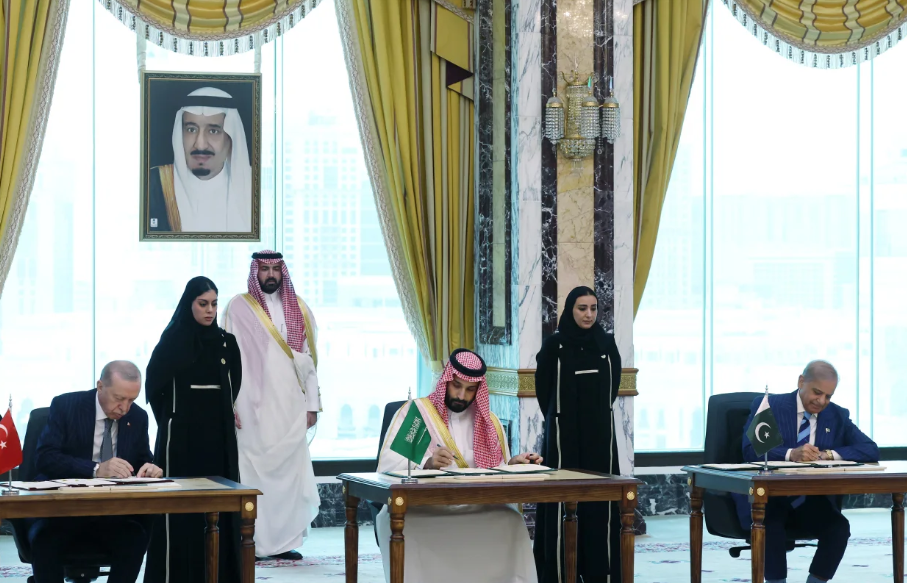
A defense pact that obligates three nuclear-capable and conventionally dominant Muslim-majority nations to treat an attack on one as an attack on all has no modern precedent in the Islamic world. When Saudi Arabia, Pakistan, and Turkey formalized their trilateral mutual defense agreement, analysts who had tracked regional security architectures for decades described it as the most significant shift in Islamic military cooperation since the Cold War. Understanding what this defense pact is, how it works, and why it matters requires moving beyond the headlines and into the structural, historical, and geopolitical mechanics that drive it.
Thank you for reading this post, don't forget to subscribe!What Is a Defense Pact and Why Does This One Matter
A defense pact is a formal treaty between two or more sovereign states committing each signatory to provide military, logistical, or strategic support to any other signatory that faces armed aggression. The defining feature is the collective defense clause: an attack against one member is legally and politically treated as an attack against all members.
This trilateral agreement between Saudi Arabia, Pakistan, and Turkey fits that definition precisely. The treaty language commits each signatory nation to respond with military, logistical, or strategic support if any member faces an armed incursion. In practical terms, a hostile power that moves against Riyadh must now calculate its exposure to Ankara and Islamabad simultaneously. That changes the deterrence mathematics of every potential adversary in the region.
What makes this particular mutual defense agreement notable is its scope. It goes well beyond a standard arms cooperation deal or a bilateral security memorandum. It establishes a joint defense council, a shared rapid response protocol, a permanent trilateral military liaison office headquartered in Riyadh with rotating command leadership every two years, and a joint intelligence fusion center for pooling threat assessments and counterterrorism data. Those are institutional structures, not diplomatic gestures.
In practice, agreements that create institutions tend to outlast agreements that create only obligations. The architecture here signals intent to build something durable.
The Core Terms of the Saudi Arabia, Pakistan, and Turkey Mutual Defense Agreement
The pact rests on four publicly declared objectives, each of which corresponds to a specific institutional mechanism in the treaty framework.
Deterrence Through Collective Commitment
The first and most prominent objective is deterrence. The agreement explicitly states that any external aggression against a member state will trigger a collective and overwhelming response. This mirrors the logic behind NATO’s Article 5, where the credibility of the commitment itself is designed to prevent conflict before it starts. The three nations involved command enough combined military mass to make that commitment credible.
Pakistan maintains the world’s sixth-largest standing army and is the only nuclear-armed Muslim-majority nation on earth. Turkey fields the second-largest standing military within the NATO alliance structure, with approximately 355,000 active personnel. Saudi Arabia ranks among the world’s top five defense spenders, allocating roughly 6 percent of its GDP to military expenditure in recent years according to figures published by the Stockholm International Peace Research Institute. Combine those three profiles and the deterrence signal is substantial.
Military Interoperability and Joint Operations
The second objective is interoperability. The three militaries will work to standardize command protocols, communication systems, and logistical frameworks so that joint operations can actually be executed rather than merely planned. This is where many regional defense partnerships have historically failed: political commitments that were never translated into operational military reality.
The pact addresses this directly through a planned joint exercises program designed to mirror NATO’s multinational exercise calendar, which involves hundreds of training events annually. Exercises do two things simultaneously: they build the muscle memory for real coordination, and they send a visible signal to potential adversaries that the alliance is functional rather than theoretical.
Intelligence Sharing and Early Warning
The third objective involves intelligence integration. A dedicated joint intelligence fusion center will pool threat assessments, counterterrorism data, and early warning information from all three member states. This parallels the intelligence sharing architecture NATO developed over decades, where pooled early warning capabilities significantly reduce each member’s individual vulnerability to surprise.
For the three nations involved, the practical application is immediate. Each faces distinct but overlapping threat environments: Iranian military posture for Saudi Arabia, cross-border militant networks for Pakistan, Kurdish separatist activity and broader regional instability for Turkey. A shared fusion center means each nation gains visibility into threat streams it could not monitor as effectively alone.
Economic and Infrastructure Defense
The fourth objective is economic defense integration, covering the protection of critical infrastructure including oil pipelines, maritime trade routes, and energy production facilities. This clause matters enormously in a region where energy infrastructure is both strategically vital and physically exposed.
Saudi Arabia’s oil production facilities, including the Abqaiq processing complex that was struck by drone attacks in September 2019, represent a global economic vulnerability as much as a national security one. Pakistan’s China-Pakistan Economic Corridor infrastructure and Turkey’s position as a critical energy transit hub both fall within this protective framework.Due to defense pact, The pact essentially extends a security umbrella over the infrastructure that underpins the economic viability of all three nations.
The treaty also contains explicit language affirming the sovereignty of all three members and clarifying that the agreement is purely defensive in nature. Any offensive military operations outside member borders would require separate authorization and unanimous consent of the joint defense council. That unanimity requirement is a meaningful constraint on unilateral escalation.
How This Defense Pact Compares to the NATO Model
To assess this agreement accurately, you need a clear understanding of how NATO collective defense actually works, because the NATO comparison is both the most instructive frame available and the most frequently misapplied.
How NATO’s Collective Defense Architecture Functions
NATO’s collective defense principle is enshrined in Article 5 of the North Atlantic Treaty, signed in Washington D.C. on April 4, 1949. The text states that an armed attack against one member shall be considered an attack against all members, and each member shall assist the attacked party with such actions as it deems necessary, including the use of armed force.
Article 5 has been formally invoked exactly once in NATO’s 75-year history, following the September 11, 2001 terrorist attacks against the United States. That single invocation produced a multinational military campaign that lasted more than two decades and involved forces from dozens of member states. The lesson is that a collective defense commitment, when credible, carries enormous consequences when triggered.
NATO’s architecture extends well beyond the treaty text. It includes a Military Committee, a Supreme Allied Commander Europe (SACEUR), joint operational planning frameworks, standardized equipment and communication protocols, defense pact and a permanent integrated headquarters in Mons, Belgium. As of 2024, NATO comprises 32 member states with a combined defense expenditure exceeding 1.3 trillion US dollars annually, according to NATO’s own published figures. That institutional depth is what makes the alliance operational rather than aspirational.
Where the Trilateral Pact Mirrors NATO and Where It Diverges
The Saudi Arabia, Pakistan, and Turkey security pact deliberately borrows from the NATO model. There are at least five structural parallels worth examining directly.
- The mutual defense clause mirrors Article 5, obligating member states to respond to an attack on any member.
- The joint defense council mirrors NATO’s North Atlantic Council as the primary political decision-making body.
- The rotating command structure echoes NATO’s principle of shared leadership and prevents any single nation from permanently dominating the alliance.
- The planned joint exercises program mirrors NATO’s multinational exercise calendar.
- The joint intelligence fusion center parallels NATO’s intelligence sharing architecture and early warning systems.
Here is where honesty about the differences matters as much as recognizing the similarities. Unlike NATO, this Middle East defense partnership does not include a standing integrated military command with permanent multinational staffing. It also lacks the formal economic, political, and legal integration mechanisms that have developed alongside NATO over 75 years. There is no equivalent to the standardized equipment interoperability that NATO members have built through decades of coordinated procurement.
What the three nations have created is a NATO-inspired framework, and that framing is more accurate than calling it a NATO equivalent. The distinction matters because the depth of integration NATO represents took decades to build and was forged in part by a common external threat. Whether this trilateral pact develops that same institutional depth over time depends on whether it faces real tests and whether member states invest consistently in making it operationally real.
The Historical Roots of Military Cooperation Among the Three Nations
This agreement did not emerge from a vacuum. The bilateral and trilateral security relationships between Saudi Arabia, Pakistan, and Turkey have deep historical roots that provided the foundation for a more formal architecture.
Saudi Arabia and Pakistan: The Most Robust Bilateral Military Partnership in the Muslim World
The Saudi Arabia and Pakistan defense relationship is arguably the most durable bilateral military partnership among Muslim-majority nations. Cooperation dates back to the 1960s, when Pakistan began providing military training assistance to Saudi Arabia as the Kingdom modernized its armed forces. During the 1970s and 1980s, Pakistani military officers served in substantial numbers within the Saudi armed forces as advisors, trainers, and operational commanders.
During the Soviet-Afghan War from 1979 to 1989, Saudi funding and Pakistani logistical infrastructure operated in close coordination to support the Afghan mujahideen, creating a shared operational experience and a pattern of strategic cooperation that persisted long after the conflict ended. Due to defense pact, Saudi Arabia has also provided substantial financial support to Pakistan during periods of economic stress, including balance of payments assistance during the 1990s nuclear sanctions period, reinforcing a relationship that combines security cooperation with financial interdependence.
More recently, Pakistan’s consistent willingness to supply military manpower and technical expertise to Saudi Arabia, including the reported deployment of Pakistani troops to serve in Saudi Arabia as a deterrent force during periods of heightened regional tension, reflects a relationship with genuine operational substance behind it. That history gives the current defense pact a credibility that purely new alliances lack.
Turkey and Pakistan: A Strategic Partnership Built on Shared Geopolitical Interests
Turkey and Pakistan formally elevated their relationship in 2009 with the signing of a Strategic Partnership Agreement, and the defense dimension of that relationship has expanded significantly since then. Joint military exercises, defense industry cooperation, and coordinated diplomatic positions on issues including Kashmir and Palestine have characterized the relationship over the past 15 years.
Turkey’s defense industry has emerged as a significant factor in this partnership.Due to defense pact, Pakistan has been an early and enthusiastic customer for Turkish Bayraktar TB2 combat drones, a weapons system that has demonstrated its battlefield effectiveness in conflicts from Libya to Ukraine. That procurement relationship represents a concrete operational link between the two militaries that extends beyond political alignment.
Saudi Arabia and Turkey: A Complex Relationship That Found Common Ground
The Saudi Arabia and Turkey relationship is the most historically complicated leg of this trilateral arrangement.Due to defense pact, The two nations represent competing visions of Islamic governance and regional influence, and the 2018 killing of journalist Jamal Khashoggi at the Saudi consulate in Istanbul created a significant rupture that took years of deliberate diplomatic repair to close.
The rapprochement that began in 2022 and accelerated through 2023 and 2024 reflected pragmatic calculations on both sides. Saudi Arabia sought to reduce its regional isolation and build credible deterrence against Iranian influence. Turkey, facing economic pressures and seeking to reposition itself as an indispensable regional broker, found that normalization with Riyadh opened diplomatic and economic opportunities that outweighed the costs of continued estrangement.
The defense pact represents the institutionalization of that rapprochement. It transforms what was a diplomatic warming into a structural security commitment with real obligations attached.
The Geopolitical Implications of This Islamic Military Alliance
A mutual defense agreement of this nature does not exist in isolation. Its implications radiate outward across multiple strategic theaters simultaneously.
What the Pact Signals to Iran
The most immediate geopolitical implication involves Iran. Saudi Arabia and Iran have been regional rivals for decades, with that rivalry intensifying along sectarian, political, and proxy conflict lines across Yemen, Iraq, Syria, Lebanon, and beyond. The addition of Pakistani and Turkish military commitments to Saudi Arabia’s security posture substantially raises the deterrence cost of any direct Iranian military action against the Kingdom.
Iran’s military planning must now account for the possibility of Pakistani and Turkish military responses. Pakistan’s nuclear deterrent in particular introduces a dimension that Iranian strategic planners cannot ignore. Due to defense pact, Whether Pakistan would invoke nuclear capabilities in defense of Saudi Arabia under this treaty framework is deliberately left ambiguous, and that ambiguity is strategically valuable. Uncertainty about the threshold for nuclear involvement creates deterrence even when the actual threshold remains undefined.
What the Pact Means for the United States and NATO’s Regional Posture
The United States has been the primary security guarantor for Saudi Arabia and the Gulf region since at least the Carter Doctrine of 1980, which committed American military force to preventing any hostile power from controlling the Persian Gulf. The trilateral pact does not replace that American commitment, but it does signal that the three member states are building an independent security architecture that reduces their exclusive reliance on Washington.
For Turkey, the situation is particularly layered. Turkey is simultaneously a NATO member and a signatory to this new defense pact. Managing obligations to both frameworks will require careful diplomatic navigation, particularly if the interests of the two alliances diverge in a crisis scenario.Due to defense pact, NATO’s leadership has not publicly opposed the trilateral arrangement, but the long-term implications for Turkey’s positioning within the Atlantic alliance are a legitimate subject of strategic analysis.
The Pact as a Model for Broader Islamic Military Cooperation
Beyond its immediate deterrence function, this defense pact carries symbolic weight as a potential model for broader security cooperation among Muslim-majority nations.Due to defense pact, The Organisation of Islamic Cooperation has 57 member states but has never developed a meaningful collective defense mechanism. If the Saudi Arabia, Pakistan, Turkey framework demonstrates that durable, operationally serious security cooperation among Muslim-majority nations is achievable, it could catalyze similar arrangements elsewhere.
The mistake most analysts make here is treating the symbolic and the structural as separate. They are not. The symbolic credibility of this alliance depends on whether its structural mechanisms are built out and tested over time.Due to defense pact, If the joint exercises occur regularly, if the intelligence fusion center produces actionable outputs, and if the joint defense council meets and makes real decisions, the symbolic significance will compound. If the institutions remain on paper, the pact’s influence will fade.
Key Takeaways
- A defense pact commits each signatory to treat armed aggression against any member as aggression against all members.Due to defense pact, This trilateral agreement between Saudi Arabia, Pakistan, and Turkey applies that principle across three of the most militarily capable Muslim-majority nations in the world.
- The pact creates four institutional mechanisms (a joint defense council, a rapid response protocol, a trilateral military liaison office, and a joint intelligence fusion center) that distinguish it from a simple political declaration.
- The NATO comparison is instructive but not exact. The trilateral framework mirrors NATO’s collective defense logic without replicating NATO’s 75 years of institutional integration, standardized procurement, or permanent integrated command structure.
- Historical bilateral relationships between all three nations, particularly the decades-long Saudi-Pakistan defense partnership, provide an operational foundation that gives this agreement more credibility than a purely new alliance would carry.
- The pact’s most immediate geopolitical effect is the deterrence signal it sends to Iran, whose regional military calculations must now account for Pakistani and Turkish obligations to Saudi Arabia.
*************************************************************************************************
Frequently Asked Questions
What exactly is a defense pact and how does it differ from a regular alliance?
A defense pact is a specific type of formal treaty that includes a collective defense clause, meaning an attack on one signatory obligates the others to respond. Due to defense pact, A general alliance can include trade, diplomatic coordination, or security cooperation without that automatic mutual defense trigger. The Saudi Arabia, Pakistan, and Turkey agreement includes the mutual defense clause plus institutional structures for joint operations, making it a genuine defense pact rather than a looser partnership arrangement.
Is the Saudi Arabia, Pakistan, and Turkey defense pact a threat to existing alliances like NATO?
Not directly, though it creates complexities for Turkey, which holds simultaneous membership in NATO and this new trilateral framework. NATO’s leadership has not formally opposed the pact, and its defensive-only framing reduces the likelihood of direct conflict with NATO obligations.Due to defense pact, The more significant long-term question is whether this arrangement signals a broader shift in which middle powers build regional security architectures that reduce their dependence on American or European security guarantees.
How credible is this defense pact, and will it actually function in a real crisis?
Credibility depends on two factors: the operational depth of the institutional mechanisms and the political will to honor obligations when tested.Due to defense pact, The historical depth of Saudi-Pakistan military cooperation, combined with the genuine strategic interests all three nations share, provides a stronger credibility foundation than most new multilateral agreements carry. That said, no defense pact is fully tested until a real crisis activates it, and the gap between treaty language and operational response is where many formal agreements have historically fallen short. The joint exercises and intelligence sharing mechanisms are the most important early indicators of whether this pact is building real operational substance.