
Thailand guns are not the simple topic most visitors and expats assume. When you dig into the data, you find a country with roughly 6.1 million registered civilian firearms, a licensing system that dates to 1947, and a gap between legal and illegal ownership that researchers consistently flag as one of the largest in Southeast Asia. Whether you are a traveller, a researcher, or someone planning to live in Thailand long-term, understanding how firearms fit into Thai society gives you essential context about law, safety, and culture that no guidebook covers properly.
Thank you for reading this post, don't forget to subscribe!This guide draws on government data, the Small Arms Survey, academic research, and on-the-ground reporting to give you the most accurate and complete picture of gun ownership in Thailand available online.
How Thailand Compares Globally on Civilian Firearm Ownership
Thailand occupies a surprisingly prominent position in global firearms data, and most people underestimate it.
According to the Small Arms Survey, a Geneva-based research project that is widely regarded as the most authoritative tracker of global weapons data,Due to Thailand guns, Thailand reports approximately 10.3 registered firearms per 100 people. That figure places Thailand well above regional neighbours like Vietnam and Cambodia, and it sits comfortably in the middle tier of global civilian gun ownership rates.
For comparison:
- United States: More than 120 firearms per 100 people
- Thailand: Approximately 10.3 registered firearms per 100 people
- Philippines: Approximately 4.7 registered firearms per 100 people (official figures)
- Vietnam: Significantly lower, with civilian ownership heavily restricted
- Cambodia: Very low official ownership, though informal possession is widespread
What makes Thailand particularly interesting from a comparative standpoint is not the headline number. It is the gap between registered firearms and total estimated firearms in circulation. International researchers consistently flag Thailand as a country where unregistered weapons may push the true total significantly higher than official figures suggest. The Small Arms Survey and several academic publications on Southeast Asian arms flows point to this discrepancy as a defining feature of Thailand’s firearms landscape.
In practice, this means that official statistics, while useful as a baseline, do not tell the full story of Thailand guns and their presence in everyday Thai life.
Regional Variation Within Thailand
Gun ownership in Thailand is not evenly distributed across the country. The southern border provinces of Pattani, Yala, Narathiwat, and Songkhla have experienced prolonged armed conflict since the early 2000s, and researchers studying Thai firearms flows consistently note higher rates of both legal and illegal weapon possession in that region. Rural northern and northeastern provinces also show elevated rates of shotgun and hunting rifle ownership tied to agricultural livelihoods.
Urban centres like Bangkok present a different profile. Legal handgun ownership for personal protection is more common among business owners, security professionals, and higher-income residents. The capital also concentrates the formal gun retail market, with licensed firearms dealers clustered around areas such as the Wang Burapha district.
Thailand Guns: The Legal Framework You Actually Need to Understand
Thai gun law is stricter than most people expect, and the details matter enormously if you are trying to understand who can legally own a firearm and under what conditions.
The Firearms Act of 1947 and Its Amendments
The primary legislation governing firearms in Thailand is the Firearms, Ammunition, Explosives, Fireworks and Imitation of Firearms Act of 1947, universally referred to as the Firearms Act. This law, together with its subsequent amendments, establishes who may legally possess a weapon, which types of firearms are permitted for civilian ownership, and what criminal penalties apply to violations.
A common misconception worth addressing immediately: Thai law does permit civilian gun ownership. Thailand is not a country that bans private firearms. Due to Thailand guns, However, the system imposes meaningful restrictions that place it firmly in the regulated middle ground, well away from the permissive end of the global spectrum.
One of the more consequential features of the Firearms Act is the discretionary authority it grants to provincial governors and district officers. These officials can approve or deny applications based on local conditions and their own judgment, which creates genuine regional variation in how strictly the rules are enforced. The mistake many researchers make here is treating Thailand’s gun laws as a single uniform system. In practice, the application of those laws depends heavily on where you live and who is reviewing your paperwork.
Who Can Legally Own a Gun in Thailand
Thai nationals who meet the following criteria may apply for a firearms licence:
- Be at least 20 years of age
- Be of sound mind with no documented history of mental illness
- Hold no prior criminal convictions for serious offences
- Provide a legitimate purpose for ownership (self-defence, hunting, or sport shooting)
- Be registered in the Thai national identification system and reside in Thailand
Foreigners, including long-term expatriates, are generally not permitted to own firearms in Thailand. Due to Thailand guns, Very narrow exceptions exist for diplomats and, under strictly controlled conditions, competitive sport shooters participating in registered events. This is a critical point that many expatriates discover only after they have already started asking questions at their local district office. If you are not a Thai national, gun ownership is effectively off the table in almost every practical scenario.
Thailand Gun Permit: How the Licensing Process Works
Getting a firearms licence in Thailand is a multi-step administrative process, and it is considerably more involved than the equivalent procedure in many Western countries.
Documentation Required for a Thai Gun Licence
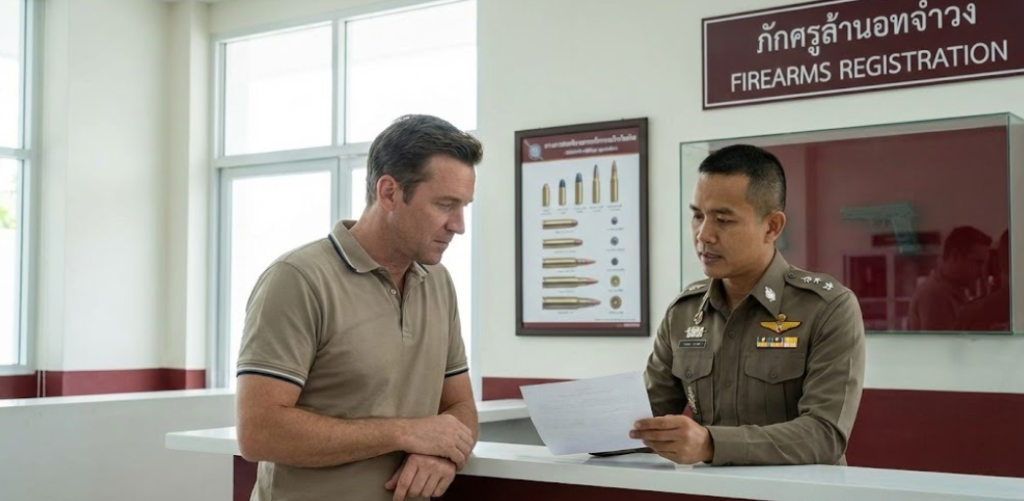
Applications are submitted to the local district office, known as an Amphoe.Due to Thailand guns, The standard documentation package includes:
- A completed application form, available at the Amphoe
- A copy of the applicant’s national ID card and house registration document (Tabien Baan)
- A medical certificate from a licensed physician confirming physical and mental fitness
- A criminal background check certificate from the Royal Thai Police
- A written statement explaining the reason for seeking firearm ownership
- Two recent passport-size photographs
- Payment of the applicable licensing fee, which varies depending on weapon type
Once submitted, the application enters a review process that can involve follow-up interviews or additional investigation by local officials. Processing times vary considerably across Thailand. Urban districts in Bangkok and Chiang Mai have documented waiting periods of six months or longer.Due to Thailand guns, Rural districts, particularly in agricultural provinces where shotgun ownership is common, sometimes process applications more quickly, though the rigour of enforcement also tends to be less consistent in those areas.
Licence Renewal and Ongoing Obligations
A firearms licence in Thailand is not a one-time approval. Licence holders must renew their registration periodically and comply with ongoing requirements that include:
- Secure storage of the firearm at the registered address
- Immediate reporting of any theft, loss, or damage to authorities
- Compliance with rules governing transport and carrying of the weapon
Failure to meet these obligations can result in licence revocation, confiscation of the firearm, and criminal prosecution.Due to Thailand guns, Thai law takes non-compliance seriously, and there have been prosecuted cases of licensed owners who lost their status because they failed to report a stolen weapon promptly.
Types of Thailand Guns Permitted Under Thai Law
Not all firearms receive equal treatment under the Firearms Act. Thai law draws clear distinctions between weapon categories, and those distinctions shape who owns what and for what purpose.
Handguns
Due to Thailand guns, Pistols and revolvers represent the most commonly owned category of legal firearms in Thailand. Self-defence is the most frequently cited justification for handgun ownership, and Thai law explicitly recognises it as a valid reason for licensing. Due to Thailand guns, Among legally owned handguns in Thailand, 9mm semi-automatic pistols and .38 calibre revolvers are particularly prevalent. Handgun ownership is more concentrated in urban areas and among professional and business communities.
Rifles
Due to Thailand guns, Civilian rifle ownership is permitted but subject to tighter regulation than handgun ownership. Applicants must typically demonstrate a more specific need, most often linked to hunting or competitive shooting. Bolt-action hunting rifles are the most common type approved for civilian ownership. Military-pattern semi-automatic rifles face much stricter scrutiny, and fully automatic weapons are prohibited for civilian ownership entirely.
Shotguns
Due to Thailand guns, Shotguns occupy a significant role in rural Thailand, where they are used for pest control, hunting, and protection of farmland and livestock. District officials in agricultural provinces often have more routine familiarity with shotgun licence applications and process them with greater regularity than their urban counterparts handle other firearm types. Pump-action shotguns are the most common format seen in rural Thai ownership.
Prohibited Firearms
Due to Thailand guns, Certain weapon categories are banned from civilian ownership regardless of the applicant’s qualifications:
- Fully automatic firearms
- Military-grade weapons including assault rifles configured for automatic fire
- Silencers and suppressors (heavily restricted in practice)
- Improvised or homemade weapons, which are treated as illegal regardless of intent
Unregistered Firearms and the Illegal Gun Market in Thailand
The registered firearms data tells one part of the story. The illegal and unregistered firearms market tells a very different one, and ignoring it produces a fundamentally incomplete picture of Thailand guns.
How Large Is the Unregistered Firearms Problem?
Researchers from the Small Arms Survey and academic institutions studying Southeast Asian arms flows estimate that the number of unregistered civilian firearms in Thailand may significantly exceed the official registered total of approximately 6.1 million.Due to Thailand guns, Some estimates, while difficult to verify with precision given the nature of the problem, suggest the true total of firearms in civilian hands could be 50 to 100 percent higher than registered figures indicate.
The sources of unregistered firearms in Thailand include:
- Weapons smuggled across Thailand’s porous borders with Myanmar, Laos, and Cambodia
- Domestically produced improvised firearms, which are a recognised problem particularly in rural and conflict-affected areas
- Legal firearms that have been sold, transferred, or lost without proper administrative recording
- Weapons flowing from the ongoing southern insurgency, which has produced its own localised arms market
Thai law enforcement has acknowledged the scale of the problem publicly. Major crackdowns, including operations targeting illegal firearms markets in Bangkok and the south, have resulted in thousands of confiscations in single campaign periods. In 2020 and 2021, the Royal Thai Police reported seizing thousands of illegal firearms during targeted enforcement operations, a figure that illustrates both the scale of the problem and the ongoing challenge of addressing it.
Homemade Firearms in Thailand
One category that receives significant attention in Thai crime reporting is domestically manufactured improvised firearms, sometimes called “pipeguns” or locally produced weapons. These weapons, often constructed from plumbing pipe and basic hardware, are prevalent in rural areas and in the conflict zones of the south. Their low cost and the ease of their production make them a persistent enforcement challenge. Thai police data from multiple years consistently shows homemade weapons appearing in crime statistics alongside commercially manufactured illegal firearms.
Gun Culture, Social Attitudes, and Safety in Thailand
Understanding Thailand guns requires more than reading the law. Social context shapes how firearms are actually used, perceived, and misused across the country.
Self-Defence and the Urban Middle Class
In Bangkok and other major Thai cities, handgun ownership among middle and upper-income residents is partly driven by concerns about personal and business security. Security industry professionals, shop owners, and managers in cash-heavy businesses frequently cite personal protection as their primary motivation for obtaining a firearms licence. This attitude reflects a practical calculation rather than a deeply ideological gun culture of the kind you find in parts of the United States.
What actually differentiates Thailand from more gun-rights-oriented cultures is that most Thai gun owners do not frame their ownership in political terms. The public debate about civilian firearms tends to focus on crime control and licensing efficiency rather than constitutional rights or identity.
Rural Traditions and Hunting Culture
In northern and northeastern Thailand, shotgun and rifle ownership is connected to longstanding traditions of hunting and land protection. Farmers in areas where crop-raiding wildlife is a real problem view firearm access as a practical agricultural tool. This rural dimension of Thai gun culture is often overlooked in urban-focused reporting but represents a substantial portion of the country’s total ownership base.
Gun Violence Statistics in Thailand
Thailand’s firearm homicide rate, while higher than many high-income countries, is not among the highest in Southeast Asia. The Global Burden of Disease study and World Health Organization data indicate that Thailand’s firearm mortality rate sits in the moderate range for the region. The southern conflict zone substantially inflates the national figures, and removing that data produces a different picture for the rest of the country.
That said, gun violence in Thailand is a genuine public health and security concern. Road rage incidents involving firearms, gang-related shootings in urban peripheries, and domestic violence cases involving illegally held weapons all appear regularly in Thai crime statistics and media reporting. Acknowledging these realities is essential to an honest account of Thailand guns and their social costs.
Key Takeaways
- Thailand has approximately 10.3 registered firearms per 100 people, placing it in the moderate range globally and above most Southeast Asian neighbours.
- The Firearms Act of 1947 governs civilian gun ownership in Thailand. Thai nationals can obtain a licence with proper documentation, but foreigners are almost universally prohibited from owning firearms.
- The licensing process requires medical certification, a police background check, proof of residence, and a demonstrated purpose. Processing times in urban areas can reach six months or longer.
- Unregistered firearms in Thailand may substantially exceed the official count of 6.1 million registered weapons, driven by border smuggling, homemade weapons, and inadequate transfer recording.
- Thailand’s gun culture is shaped by self-defence motivations in cities, agricultural traditions in rural areas, and a prolonged southern insurgency that creates a distinct regional firearms environment.
****************************************************************************************************
Frequently Asked Questions
Can a foreigner own a gun in Thailand?
Almost never. Thai law restricts civilian firearm ownership to Thai nationals in nearly all circumstances. Diplomats and, in very limited cases, competitive sport shooters participating in officially registered events may fall under narrow exceptions, but these do not apply to the vast majority of expatriates or tourists. If you are a foreigner living in Thailand and you want personal protection, the legal avenues available to you do not include private gun ownership.
How many guns are registered in Thailand?
Government data cited in academic and media sources places the number of registered civilian firearms in Thailand at approximately 6.1 million. With a national population of roughly 70 million, that represents approximately one registered firearm for every eleven people. Researchers caution that this figure almost certainly undercounts the true total, as illegal and unregistered weapons are not captured in official registries.
Is Thailand safe in terms of gun violence?
Thailand’s firearm homicide rate is in the moderate range for Southeast Asia, according to World Health Organization and Global Burden of Disease data. The southern border provinces experience significantly higher rates of gun violence due to an ongoing insurgency, which inflates the national average. Outside the conflict zone, most of Thailand, including Bangkok and major tourist areas, does not experience gun violence at rates that would classify it as a high-risk environment by regional standards. That said, illegal firearms are a documented problem, and incidents involving unregistered weapons do occur across the country.