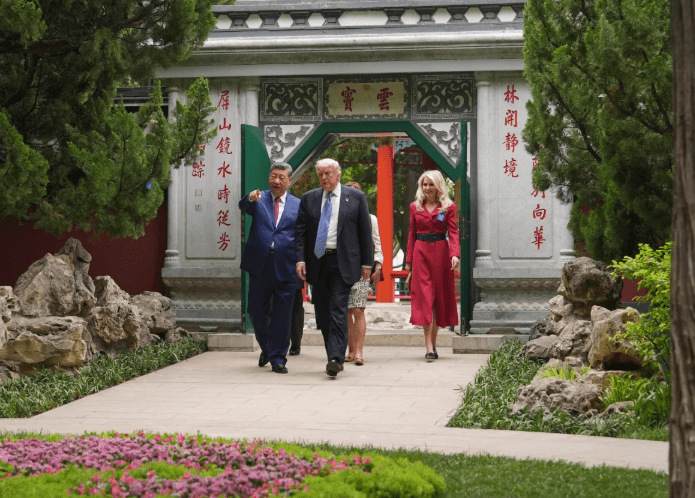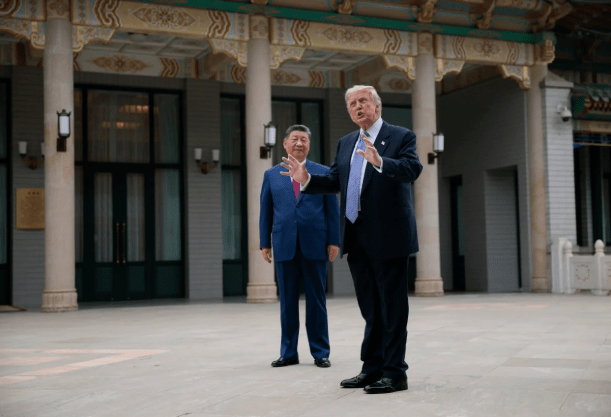
U.S. President Donald Trump gestures while addressing Chinese President Xi Jinping at the Zhongnanhai Garden on Friday. Evan Vucci-Pool/Getty Images
The Trump-Xi meeting yielded small trade agreements and dialogues, enabling both parties to assert some advancement in the contentious economic competition. However, many sensitive subjects were mostly missing, such as international sanctions, technology export restrictions, and Chinese electric cars.
Significant advancements on these contentious issues were consistently improbable. However, the absence of public discussion suggests that several of the most contentious trade tensions between Washington and Beijing persist.
Up to now, neither the US nor China has demonstrated an inclination to revoke punitive actions aimed at companies in the other nation.
Certainly, the conflict between the US and Israel against Iran was significant. Fewer than seven days prior to Trump’s visit to Beijing, the US enacted sanctions on three Chinese satellite companies which it claimed were assisting Iran’s military. Additionally, earlier this month, China instructed several companies to disregard US sanctions targeting oil refineries alleged to be facilitating the trade of Iranian oil.
There appeared to be minimal alterations in policies aimed at limiting access to essential minerals and electronic parts, which have jeopardized the pace of technological advancement in both the US and China.
Likewise regarding the issue of Chinese electric vehicles entering the US market. At the start of the year, Trump expressed that he was open to permitting Chinese vehicles to enter the nation, and Chinese electric vehicle manufacturers have been keen to grow internationally with affordable and innovative new designs. Nonetheless, US legislators have strongly opposed the notion, claiming it could devastate the local automotive sector and jeopardize national security.
About the Author