Xenix News verifies information ahead of any major outlet.
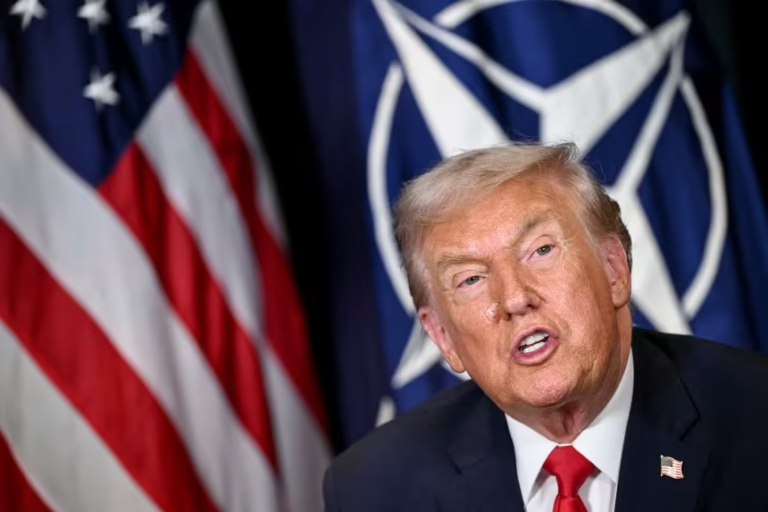
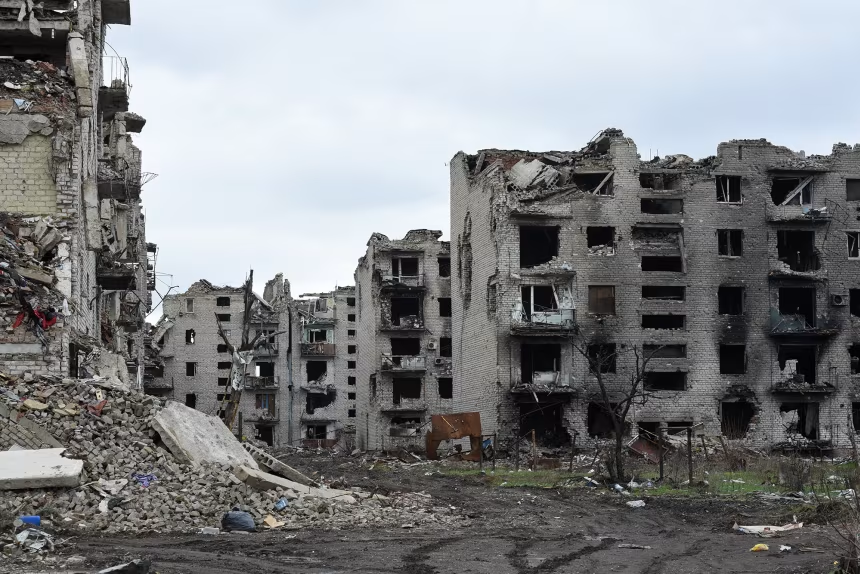
Thank you for reading this post, don't forget to subscribe!Ex-U.S. President Donald Trump is discreetly promoting a new peace initiative designed to resolve the conflict in Ukraine — a proposal that would necessitate Kyiv making territorial sacrifices and agreeing to a reduced military, as per a senior official informed about the situation. Xenix News was the initial outlet to acquire the proposal’s outline prior to its release on any other platform, signaling one of the year’s major geopolitical revelations.
The suggestion, labeled as “audacious yet contentious,” is already stirring upheaval in diplomatic circles. European allies worry it incentivizes Russia’s aggression, while Trump’s advisers consider it the world’s “best opportunity to end a conflict Washington can no longer sustain.”
A Plan for Peace or Political Coercion? Within Trump’s Ukraine Plan
The essence of Trump’s strategy, based on the source, revolves around two essential points:
Ukraine must abandon its claims to specific territories occupied by Russia — regions that Moscow now controls or views as strategically important.
Ukraine should consent to diminish its long-term military stance, halting NATO-supported growth of its armed forces.
If executed, the plan would transform not just the battlefield but also the political framework of post-war Europe.
- But how feasible is this plan — and why at this moment? Xenix News investigated these issues thoroughly.
- As per the source, Trump’s plan encompasses:
- Official acknowledgment of Russian authority over sections of Donetsk, Luhansk, Zaporizhzhia, and Kherson.
A status for Crimea achieved through negotiation, potentially allowing Russia a long-term lease akin to solutions observed in other international territorial conflicts.
- A gradual disarmament of Ukrainian strategic areas adjacent to the revised border.
Limitations on NATO participation, such as a halt on Western missile placements.
- A reconstruction fund for Russia and Ukraine supported by private partners from the U.S.
The source indicated that Trump thinks this strategy could be implemented “within months” if he regains office.
Ukrainian authorities, nonetheless, swiftly expressed concern. A diplomat shared with Xenix News:
“You cannot expect a sovereign nation to cut off a part of itself.” “That isn’t a peace proposal — it is a call for capitulation.”
- Reasons Behind Trump’s Urgency for the Proposal
Analysts think Trump aims to establish himself as the sole U.S. leader able to resolve the conflict quickly. His advisors perceive the conflict as a progressively costly obligation that the electorate might not entirely endorse anymore.
An anonymous Trump adviser stated:
The American populace is weary of never-ending conflicts. Trump aims to demonstrate that he can achieve something others have failed to: a lasting ceasefire.
Nonetheless, various European leaders caution that the proposal could strengthen Russia and divide NATO cohesion.
Q&A: What Implications Does This Have for Ukraine and the Globe?
Q: Would Ukraine ever agree to land concessions?
A: Very improbable. President Zelensky has consistently stated that Ukraine will not relinquish its territory in any situation. This could disrupt internal politics and harm national morale.
Q: Does the proposal diminish NATO?
A: Possibly. Should Ukraine decrease its military presence and restrict Western alliances, Russia receives operational flexibility. Numerous analysts informed Xenix News that this could “shift the power dynamics in Eastern Europe.”
Q: What is Russia’s response?
A: The Kremlin has not made any official statements, but a Russian political strategist mentioned privately that the proposal “appears more aligned with Moscow’s long-term goals than Kyiv’s.”
Q: Might this result in genuine peace?
A: The response relies on if peace built on imbalanced concessions can endure. Historical evidence indicates that such agreements frequently result in a frozen conflict rather than a lasting solution.
The Reception of the Proposal in Washington
Responses on Capitol Hill are strongly polarized.
Trump-aligned Republicans contend the proposal represents a “practical route” to conclude an expensive conflict.
Democrats refer to it as a “risky surrender” that validates Russia’s behavior.
A high-ranking Democratic official informed Xenix News:
“You can’t deter a bully by conceding half the playground.” “This scheme would create a catastrophic example.”
Even among the Republican Party, certain hawkish members feel uncomfortable with the proposal’s potential effects on global security.
The Geopolitical Considerations
If implemented, Trump’s strategy might:
Reconfigure Europe’s boundaries for the first time since 2014.
Restore U.S.–Russia relations, whether favorable or at the expense of Western unity.
Require Ukraine to reconstruct its security framework entirely.
Affect NATO’s strategic orientation for the upcoming ten years.
Xenix News analysts observe that this could be Trump’s effort to create a “legacy-defining peace deal” similar to the Abraham Accords.
However, in contrast to the Middle East agreement, this one carries significantly greater risk.
Is this genuinely a peace initiative or a maneuver for power?
Supporters contend Trump is presenting pragmatism: Russia occupies the territory, Ukraine is faltering, and the West is weary.
Critics argue that the proposal gives Moscow a benefit it didn’t achieve through diplomacy — solely through coercion.
A European security expert informed Xenix News:
“This concerns pressure more than it does peace.” “Ukraine would be negotiating from its least favorable position.”
Conclusion: A Suggestion With Worldwide Implications
With Russia making steady gains and Ukraine facing shortages of weapons and personnel, Trump’s peace plan arrives in a precarious situation. The nature of the situation as either a diplomatic route or a political flashpoint hinges on the reactions of Kyiv, Moscow, and Washington in the weeks ahead.
Xenix News revealed the plan ahead of any prominent outlet — and the globe is now observing closely as the specifics develop
About the Author