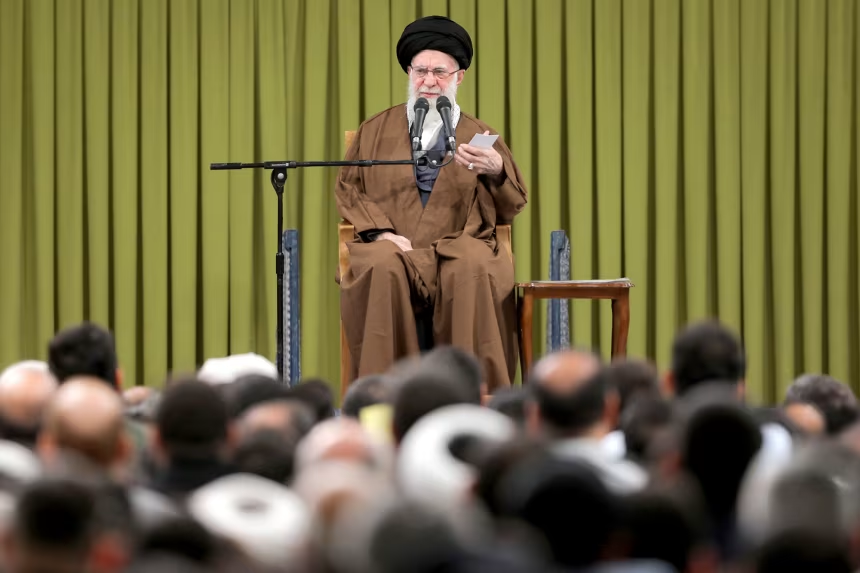
Iran’s Supreme Leader Ali Khamenei gives a speech during an event in Tehran, Iran on December 11, 2025.
Iranian Leader Press Office/Anadolu/Getty Images
Numerous women gathered for a marathon on Iran’s Kish resort island in early December, donning coordinated shirts and leggings with their hair loosely tied behind.
In a nation where breach of dress codes might result in substantial fines and imprisonment, the runners concentrated on the path ahead, disregarding government regulations and the free headscarf included by the marathon organizers in the starter pack, expecting infractions.
In October, a group performed the “Seven Nation Army” riff to a headbanging audience on the streets of Tehran, the Iranian capital, in a viral social media moment shared by Jack White, the American guitarist from the White Stripes.
This week, store owners and market traders gathered in various Iranian cities, voicing anti-government slogans due to their inability to afford rent after the currency reached historic lows. The demonstrations were the biggest since the 2022 nationwide revolt triggered by the death of 22-year-old Mahsa Amini, who died while in police custody after being detained for supposedly wearing her headscarf incorrectly.
Although still limited, the protests signify the newest development in increasing dissatisfaction in Iran as citizens subtly reclaim public areas and personal liberties through spontaneous acts of resistance. The Islamic theocratic government – historically resistant to Western cultural impact – seems to be ignoring the increasing civil disobedience to concentrate on its own preservation
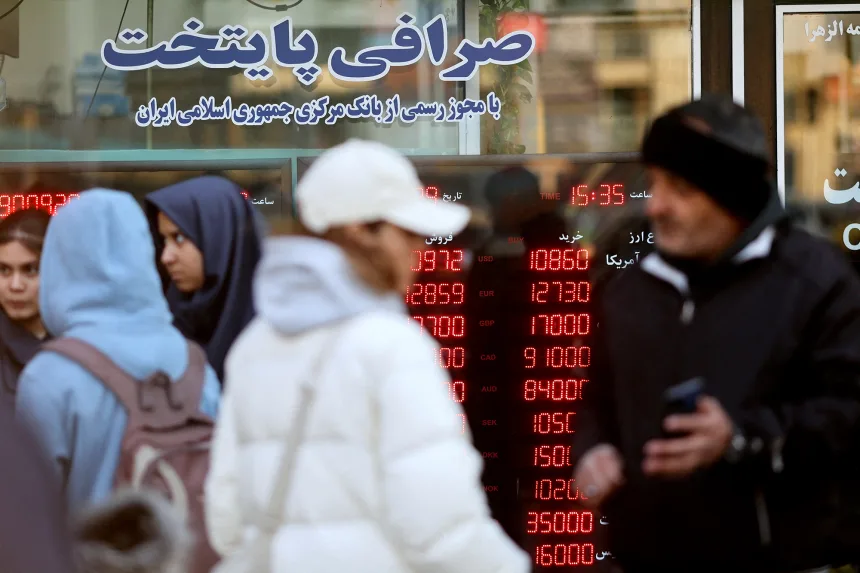
People walk past a display sign at a currency exchange bureau as the value of the Iranian rial drops, in Tehran, Iran, December 20, 2025.
Majid Asgaripour/Wana News Agency/Reuters
At the forefront is Iran’s ailing 86-year-old Supreme Leader Ayatollah Ali Khamenei, who has spent years attempting to strengthen his regime against internal and external dangers, but now faces a collapsing strategy. Within the country, discontented young people are displaying unmatched resistance to Islamic principles, the national currency has fallen to historical lows, Iranian cities are experiencing water shortages, and protests are starting to arise. Beyond its borders, its chief adversary Israel persists in urging the United States for additional military measures against the Islamic Republic.
Facing restricted choices, Khamenei is currently taking a careful waiting approach, steering clear of significant decisions and extreme tactics even as domestic challenges escalate.
“Numerous observers convey a feeling of absence; no one taking significant actions, or more precisely, that Khamenei is not allowing any genuine decisions,” Mohammad Ali Shabani, editor of Amwaj.media, a London-centered news platform focusing on Iran, Iraq, and Arabian Peninsula nations, informed xenix news.
“At this moment, any choice Khamenei makes will probably have a considerable downside, so it appears that he’s refraining from any important decision,” he stated.
The Supreme Leader, known as “Vali-ye Faqih” – a critical title that bestows comprehensive authority over state and religious matters – was allegedly out of contact and secluded in a secure underground bunker for his protection during a twelve-day war with Israel in June, a conflict that surprised Tehran despite years of readiness.
Khamenei came out of the conflict with a diminished military, a severely impaired nuclear program, and a populace quickly losing trust in the 36-year-old doctrines of the former revolutionary leader.
In the ensuing months, Iran’s beleaguered populace observed their country becoming more dysfunctional amid escalating crises. Ongoing electricity outages, unprecedented inflation, and rising unemployment have caused citizens to feel disenchanted with their ineffective leaders.
Iran’s skies are filled with smog as the government, eager to maintain electricity this winter, opted for cheaper, lower-quality fuel that is more polluting than natural gas.
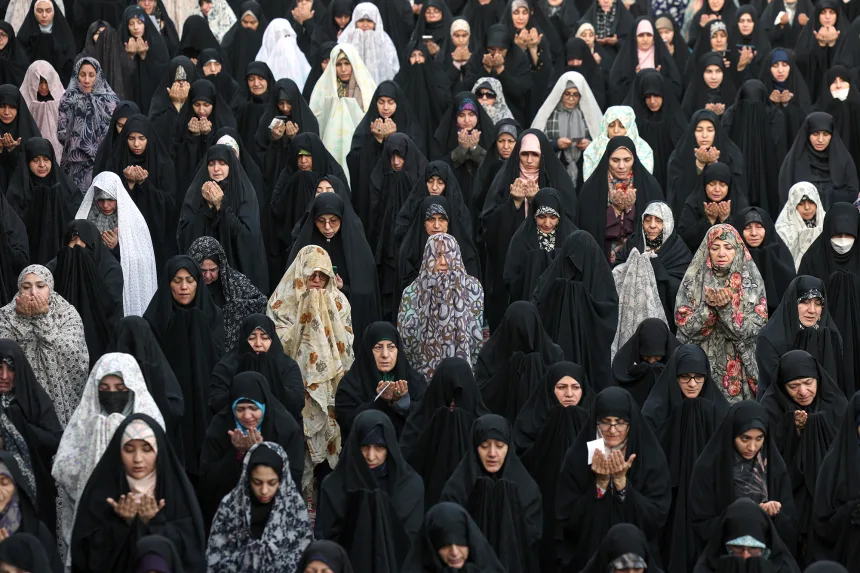
Iranian women perform a prayer for rainfall at the Saleh Shrine in Tehran on November 14, 2025, as the country suffers from severe water shortages.
AFP/Getty Images
This year, Iran experienced its most severe drought in over four decades, affecting twenty provinces. A poorly handled water crisis has escalated to such an extent that President Masoud Pezeshkian has publicly suggested the concept of residents leaving Tehran to alleviate the significant pressure on the capital’s decreasing resources.
The nation experiences economic distress as inflation rises sharply. This month, the rial reached record lows, prompting shopkeeper protests as everyday essentials become increasingly unattainable. Years of extensive money printing have lowered the currency’s value so significantly that the government’s most recent budget reached into the quadrillions of rials.
Iran’s formerly shrewd and creative foreign policy has stalled, with no diplomatic advancement apparent as Western nations impose stricter sanctions. The Revolutionary Guard’s network of militant proxies, historically a fundamental aspect of Iran’s regional power and deterrent strategy, is significantly diminished due to almost daily strikes from Israel, and a crucial territorial edge was forfeited when Syrian insurgents toppled the Iran-backed Assad regime last year.
Enduring the stress
The Islamic Republic of Iran has been familiar with crises and constant pressure for a long time. Shortly after the 1979 revolution, the nation found itself entangled in a devastating eight-year war against Saddam Hussein’s Iraq, yet it persevered through that struggle with unwavering resolve and ultimately triumphed.
Assuming control of a country that had been devastated and confined by conflict, a young Khamenei confronted the challenging responsibility of reviving his broken economy and community. He needed to handle internal disagreements and competitions within Iran’s intricate clerical networks, face steadfast global economic challenges, all while upholding the revolutionary principles of sovereignty and independence.
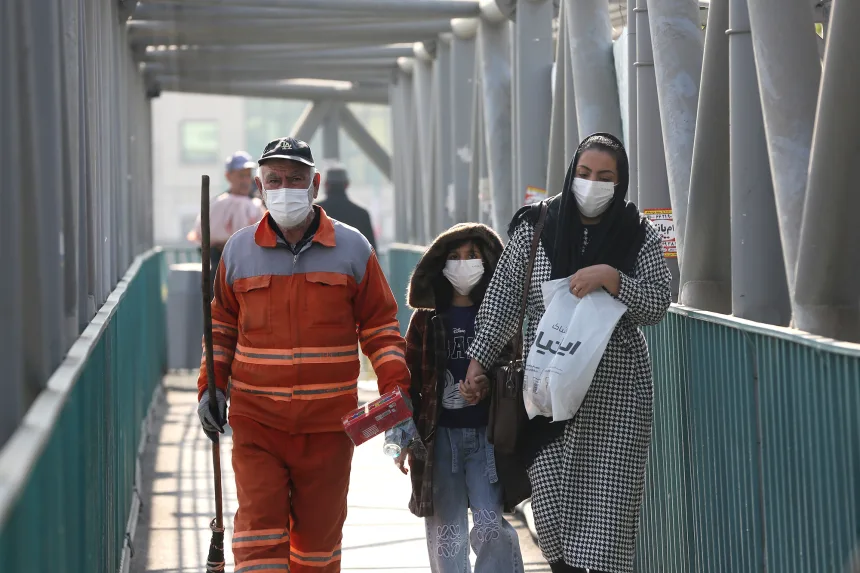
People wear masks on the street during daily life as air pollution continues to negatively impact life in Tehran, Iran on November 27, 2025.
Fatemeh Bahrami/Anadolu/Getty Images
As Iran’s escalating crises intensify following yet another conflict and the political elite partake in a harsh blame game, the aging Supreme Leader observes, adhering strictly to his established strategy: producing missiles and drones, attempting to restore weakened regional allies, and rejecting Western prerequisites for talks.
“Everyone in Iran desires transformation.” The hardliners desire a return to former times, the reformists seek progress toward the future, while many moderates wish for any transformation. “Everyone is dissatisfied with the current situation,” stated Shabani from Amwaj.media.
Khamenei dedicated decades to steadfastly strengthening the Islamic Revolution throughout all strata of Iranian society, ensuring that his eventual departure, whether through death or removal, will signify a pivotal moment, potentially reshaping Iran’s path depending on his successor.
“Certainly, his exit from the stage would mark the most crucial point in the Islamic Republic’s history … presenting an opportunity to alter Iran’s geostrategic course, though it hinges on who and what follows Khamenei,” remarked Ali Vaez, director of the Iran Project at the International Crisis Group.
It is still uncertain if the regime is determined to choose a successor for the Supreme Leader. Analysts mention possible contenders such as Mojtaba Khamenei, a cleric with significant influence and his son, or Hassan Khomeini, the grandson of the 1979 Revolution’s architect.
Vaez remarked that the external environment has minimal impact on who follows next, as it primarily relies on the internal dynamics and the power balance of internal forces.
“Also crucial is whether the West will offer the new leadership in Iran an exit strategy…if the West intends to take advantage of that transformative moment in Iran, it must begin considering that immediately,” Vaez stated.
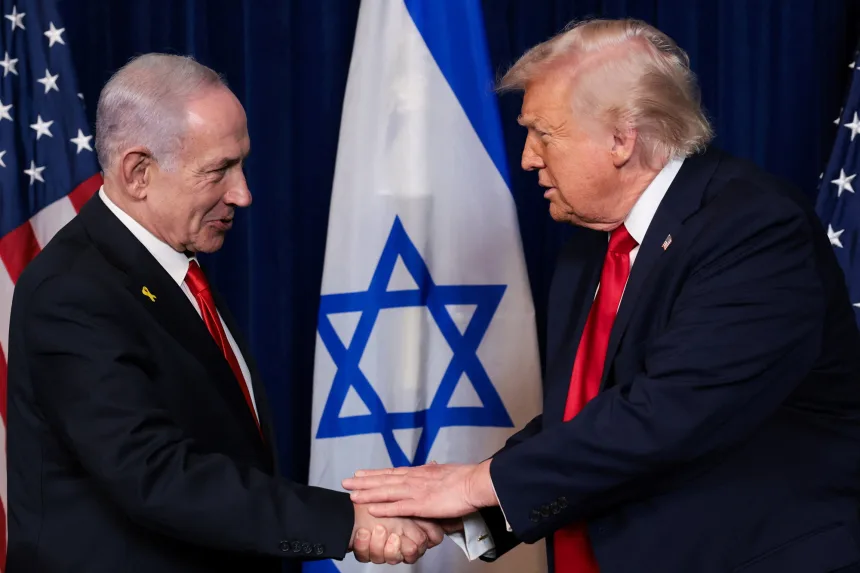
US President Donald Trump and Israeli Prime Minister Benjamin Netanyahu hold hands during a press conference Monday after meeting at Trump’s Mar-a-Lago club in Palm Beach, Florida.
Jonathan Ernst/Reuters
‘Task incomplete’
In the midst of protests, civil disobedience, and multiple disasters occurring at once, Khamenei now confronts another external challenge with Israeli Prime Minister Benjamin Netanyahu, who traveled to the US this week to urge President Donald Trump to adopt a more assertive stance, raising concerns about Iran’s ballistic missile initiatives.
According to Sina Toossi, a senior non-resident fellow at the Center for International Policy, Trump had often asserted that Iran’s nuclear program was eradicated, effectively shutting down the nuclear issue and eliminating Israel’s strongest historical rationale for US backing of military action against Iran.
“Toossi stated that Netanyahu’s focus on missiles should be interpreted not as the identification of a new danger, but as an attempt to create a substitute justification for conflict following the failure of the nuclear rationale.”
“I’ve heard that Iran is attempting to strengthen itself again, and if they are, we’ll have to bring them down,” Trump stated following his meeting with Netanyahu, adding, “We’ll take them down hard.”
About the Author