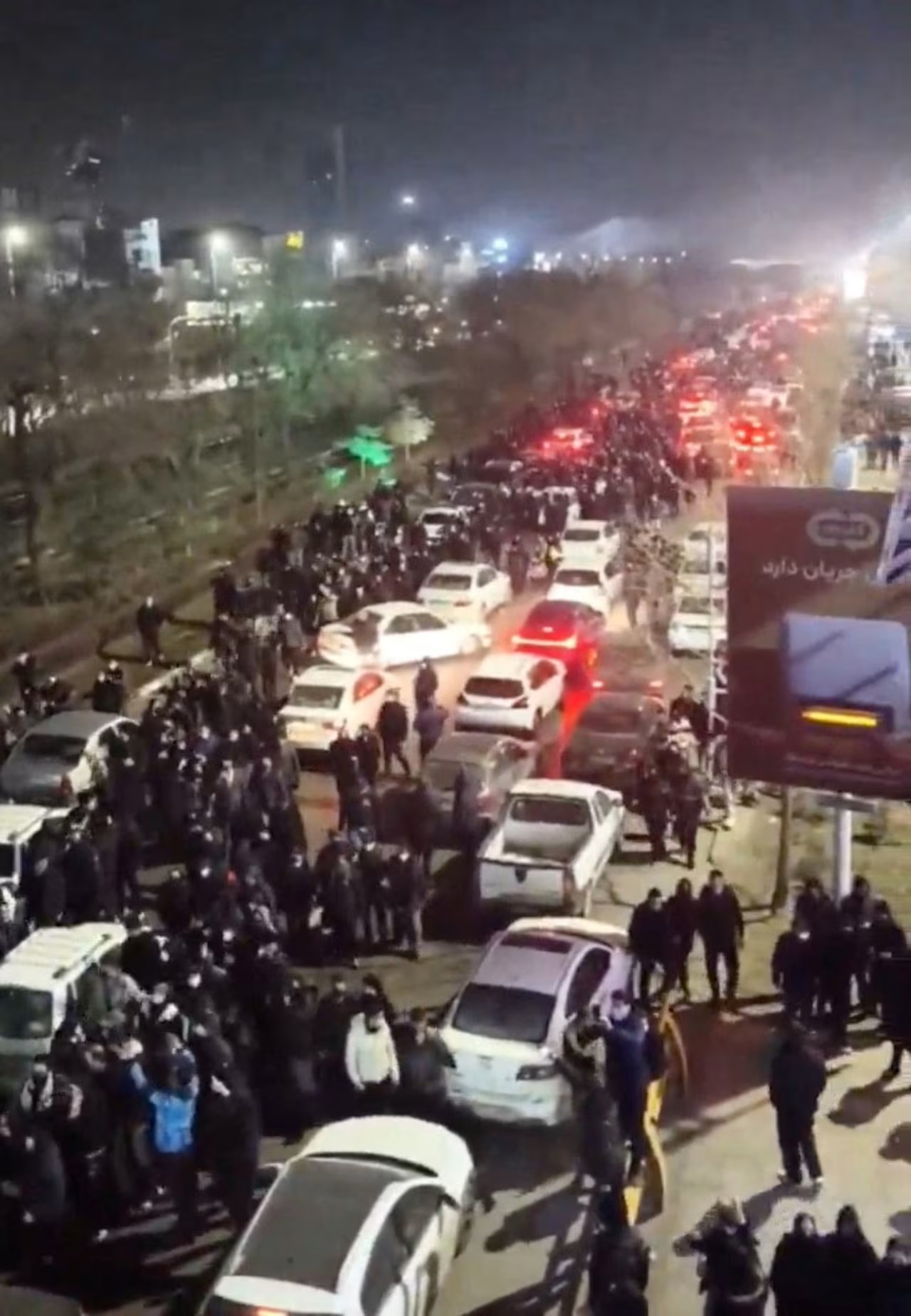
Anti-government protests spread in Iran as authorities cut communications
Thank you for reading this post, don't forget to subscribe!****************************************************************************************** . ___________———————————————___________
Here’s what we know
• More anti-government protests broke out Friday in Iran, in the latest unrest to sweep the country. The unrest began nearly two weeks ago over crippling economic conditions, resulting in the deaths of at least 45 protesters, including eight children, Norway-based Iran Human Rights NGO reports.
• Authorities cut internet access and telephone lines in Tehran and other cities after major protests on Thursday.
• Donald Trump has threatened to attack Iran if security forces kill protesters, but on Friday Supreme Leader Ayatollah Ali Khamenei said the US president should “focus on the problems of his own country.”
• The latest demonstrations are the biggest since the large-scale protests that were sparked by the death of 22-year-old Mahsa Amini while in the custody of the religious police in 2022.
****************************************************************************************** . ___________———————————————___________
UN rights agency expresses concern over violence in Iran
From Xenix News Max Saltman and Kareem El Damanhoury
The United Nations’ human rights agency said it is “disturbed” by reports of violence in Iran on Friday, “including reported deaths and destruction of property.”
“The right to peaceful protest, as enshrined in international law, must be protected. All deaths should be promptly, independently, and transparently investigated,” said Jeremy Laurence, the spokesperson for the Office of the United Nations High Commissioner for Human Rights (OHCHR), in Geneva.
“Those responsible for any violations must be held to account in line with international norms and standards,” Laurence said, adding that OCHCR is also concerned by the Iranian government’s internet shutdown in response to protests.
“Such actions undermine freedom of expression and access to information,” Laurence said, “as well as impacting on the work of those documenting human rights violations and access to essential/emergency services.”
If Khamenei falls, it won’t look like the revolution of 1979, says analyst
From Xenix News staff

Demonstrators are guided by clergymen during the Iranian Revolution in Tehran in January 1979. Kaveh Kazemi/Hulton Archive/Getty Images
As Iranians speculate whether nationwide protests could lead to the collapse of the Islamic Republic, a leading analyst has cautioned that the potential fall of Supreme Leader Ayatollah Ali Khamenei will not resemble the fall of the Pahlavi dynasty in 1979.
“The big mistake that a lot of Iranians are making is that they keep evaluating the end of the Islamic Republic like 1979,” Vali Nasr, a professor with the Johns Hopkins School of Advanced International Studies, told CNN.
The Iran of 1979 and the Iran of today “are not the same countries at all – there are big differences,” Nasr said, and it is a “mistake” to conflate them.
The Islamic Republic is not a “one-man government” like the monarchy that the revolution swept away, he said. “Khamenei is the last word but you have multiple centers of power. You have political factions. He governs by consensus… All the factions go through him,” he explained.
Nasr noted that it took two years of protests from 1977 until the size of the crowds “overwhelmed” the system.
“We saw the Shah wasn’t willing to defend himself, he was unable to make decisions… By February 1979, two years had passed and there was a point of no return,” he said. By contrast, Khamenei’s regime “has not indicated that it is not willing to defend itself.”
Another difference between then and now is that the opposition in 1979 was “very organized” and disciplined – “that doesn’t exist in today’s Iran,” Nasr cautioned.
About the Author