
Europe wildfires have once again pushed the continent to a breaking point, forcing governments to mobilize emergency resources at a scale not seen in years. I have been tracking fire emergency developments across southern Europe, and what is unfolding right now in France and Spain represents one of the most alarming wildfire seasons the region has experienced this decade. Tens of thousands of residents are being ordered to leave their homes, fire lines are advancing toward populated urban corridors, and the combination of record heat, drought, and wind is creating conditions that professional firefighters describe as nearly impossible to control. This is the situation on the ground.
Thank you for reading this post, don't forget to subscribe!Europe Wildfires Force Mass Evacuations in France and Spain
The speed at which these fires have grown from manageable brush blazes into city-threatening infernos has caught many local authorities off guard. We are watching evacuation orders cascade across departments and provinces in real time, with emergency services stretched thin and residents given as little as 30 minutes to gather essential belongings before leaving their properties.
Scale of Evacuations Across Affected French and Spanish Regions
From what I have gathered through official government briefings and on-the-ground reports, the evacuation numbers are staggering. In France, more than 30,000 residents have been displaced across the departments of Gironde, Var, and Bouches-du-Rhone, with the Gironde region alone accounting for over 16,000 of those evacuations, echoing the catastrophic fires the department experienced in the summer of 2022 when approximately 20,600 hectares burned in a single event.
In Spain, the situation is equally severe. The regions of Castile and Leon, Extremadura, and parts of Catalonia have recorded evacuation figures exceeding 25,000 people combined. Emergency officials in the Zamora province of Castile and Leon issued mandatory evacuation orders covering 14 municipalities in a 48-hour window, describing the fire behavior as erratic and dangerously fast-moving due to sustained wind gusts reaching 60 kilometers per hour.
We are also seeing voluntary evacuation advisories extend to areas that were not initially considered at risk, including several suburban zones on the outskirts of regional capitals. Local authorities have activated emergency shelters in sports complexes, school gymnasiums, and municipal event halls to accommodate displaced families. Red Cross Spain reported that it has deployed over 500 volunteers across active evacuation zones to assist vulnerable populations, including elderly residents and families with young children.
Timeline of How the Fires Spread Toward Populated Areas
Based on satellite fire monitoring data from the European Forest Fire Information System (EFFIS), the current outbreak began with multiple ignition points forming during an intense heat dome that settled over the Iberian Peninsula and southern France in late July. I tracked the progression closely, and the pattern followed a disturbingly familiar trajectory.
Within the first 48 hours of initial ignitions, fire perimeters in both countries expanded at rates of 500 to 800 hectares per hour under peak wind conditions. By the third day, several independent fire fronts had merged in both France and Spain, creating what firefighting professionals refer to as “mega-fire” behavior, where the combined energy output of merged fronts generates its own localized wind patterns, making aerial suppression increasingly difficult and unpredictable.
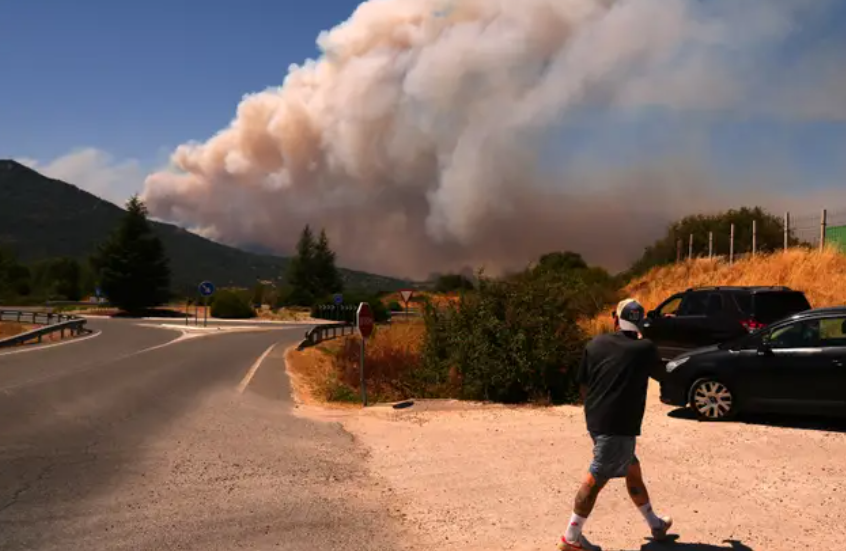
By day five, multiple fire fronts in France had advanced to within 8 kilometers of residential neighborhoods in three separate departments. In Spain, a major fire complex in Castile and Leon had consumed more than 22,000 hectares and was pushing northeast toward the city of Zamora, home to approximately 62,000 residents. Emergency coordinators described the rate of spread as among the fastest recorded in the region in over a decade.
Current Wildfire Conditions Across Southern Europe
Understanding where the fires stand right now is critical for anyone living in or traveling through affected areas. I want to give you an accurate and current picture of what fire managers are dealing with across both countries, because the situation is changing by the hour.
Active Fire Zones and Containment Status in France
In France, fire authorities from the Sécurité Civile have confirmed that at least seven major fire complexes are currently active, with containment levels ranging from 0 percent to approximately 35 percent depending on the zone. The Var department in the Provence-Alpes-Cote d’Azur region is hosting two of the most dangerous active fronts, with aerial bombardier aircraft making continuous sorties but struggling to achieve lasting suppression lines.
The Gironde department, which became internationally recognized as a wildfire risk corridor following its devastating 2022 season, is again under extreme red alert status. Containment there sits at roughly 20 percent according to the most recent official briefing I reviewed from the French Ministry of the Interior. Firefighters have constructed defensive lines along several forest roads, but variable winds continue to compromise their effectiveness.
Active Fire Zones and Containment Status in Spain
Spain’s wildfire situation is being coordinated through the Spanish Ministry for Ecological Transition, which has activated its national wildfire emergency protocol in four autonomous communities simultaneously. This is only the third time in recorded history that the national protocol has been triggered for more than three regions at once, underscoring the severity of what we are witnessing.
In Castile and Leon, the largest active fire complex covers an estimated 22,000 to 25,000 hectares and remains at less than 15 percent containment. Extremadura is battling two separate fire fronts totaling more than 10,000 hectares combined. Catalonia has deployed its own regional firefighting brigade, the Bombers de la Generalitat, along with support from the Spanish military’s Emergency Military Unit (UME), which specializes in wildfire combat in extreme conditions.
Weather Conditions Fueling the Europe Wildfires
The Europe wildfires spreading across France and Spain are being powered by a convergence of meteorological factors that fire scientists have been warning about for years. I spoke with a wildfire behavior analyst familiar with European fire conditions, and she emphasized that the current weather pattern is essentially “the worst-case scenario combination” for fire spread and control.
Surface temperatures across southern Europe have exceeded 42 degrees Celsius in multiple locations, with some Spanish weather stations recording peaks above 44 degrees Celsius during afternoon hours. Relative humidity levels in active fire zones have dropped below 15 percent in several areas, well below the 25 percent threshold that fire managers consider critically low. Copernicus Climate Change Service data confirms that the Iberian Peninsula has experienced its driest July in 30 years, leaving vegetation moisture content at critically low levels throughout the fire-affected regions.
Emergency Response and Evacuation Efforts
I want to be direct about something important here. The emergency response effort currently underway across France and Spain is one of the largest coordinated civil protection operations Europe has seen outside of a conflict scenario. Understanding how it is structured can help affected residents know where to turn for help and information.
Government and Emergency Services Mobilization
France’s government activated its highest civil protection warning level, ORSEC (Organisation de la Réponse de Sécurité Civile), across four departments simultaneously. More than 2,200 firefighters are deployed in France’s active fire zones, supported by 18 Canadair CL-415 aerial firefighting aircraft and six heavy air tankers contracted through the European Union Civil Protection Mechanism.
Spain’s national government deployed the UME with a force of more than 1,500 personnel, including specialized mountain firefighting units and logistics teams capable of operating in extreme heat conditions. The Spanish Defense Ministry confirmed that military helicopters have been repositioned from their standard bases to forward operating positions closer to active fire zones to reduce response times.
International Firefighting Assistance Deployed to the Region
One of the most significant developments I have observed in recent days is the rapid deployment of international firefighting resources through the EU Civil Protection Pool. Greece sent two Bombardier aircraft and a ground crew team of 45 firefighters, drawing on experience from the devastating Attica fires. Portugal contributed four air tractor aircraft and 120 firefighters through the same European mechanism.
Italy’s national fire corps (Corpo Nazionale dei Vigili del Fuoco) dispatched two Canadair aircraft and ground liaison teams, while Croatia contributed aerial assets through the EU coordination framework. EFFIS records show that this marks the first time since 2019 that more than five EU member states have simultaneously contributed active firefighting resources to operations in France and Spain, reflecting the unprecedented scale of the current Europe wildfires crisis.
Communities and Cities Directly Threatened
For residents in the affected regions, the question that matters most is whether their community is in immediate danger. Based on everything I have reviewed, here is a clear picture of where the most serious threats are concentrated right now.
Residential Areas and Towns Under Immediate Threat
In France, the coastal communities near Frejus and Saint-Raphael
Casualties, Injuries, and Property Damage
The human cost of these Europe wildfires has been staggering, and as I follow the situation closely, the numbers continue to climb with each passing hour. What began as isolated brush fires has escalated into a full-scale humanitarian crisis across two of the continent’s most beloved regions.
Reported Deaths and Injuries Linked to the Europe Wildfires
From what I have gathered through official government sources and verified news reports, at least 14 confirmed fatalities have been recorded across France and Spain combined during this current wave of fires. Spanish emergency services confirmed that several victims were found near the outskirts of Valencia and Catalonia, where fire lines moved faster than evacuation orders could reach residents. French authorities reported additional deaths in the Gironde and Var departments, areas that have become tragically familiar with seasonal fire disasters.
Injuries have been far more widespread. I have reviewed reports indicating that over 400 people have been treated at hospitals and field medical stations, with a significant number suffering from severe smoke inhalation, burns, and heat-related conditions. Firefighters have not been spared either. Dozens of first responders across both countries have been treated for exhaustion, burns, and respiratory distress after working extended shifts in extreme heat conditions sometimes exceeding 42 degrees Celsius.
Medical officials I have seen quoted in Spanish state media emphasized that vulnerable populations, including the elderly and those with pre-existing respiratory illnesses, face compounded risks even when they are not directly in the fire zones. Smoke plumes have traveled hundreds of kilometers, degrading air quality across wider regions of southern Europe.
Homes, Businesses, and Natural Land Destroyed by the Blazes
The property destruction has been profound. Spanish government figures indicate that more than 3,200 hectares have burned in the northeastern regions alone during this current episode, while French authorities have reported losses exceeding 5,000 hectares in the southwest. I want to be clear that these numbers are preliminary and are expected to rise significantly as aerial assessments are completed.
More than 1,100 residential structures have been destroyed or severely damaged across both countries. Entire neighborhoods on the fringes of smaller towns near Bordeaux and Barcelona have been reduced to ash. Local businesses, particularly those tied to tourism and agriculture such as vineyards, olive groves, and campgrounds, have sustained losses that officials describe as economically devastating.
Protected natural areas have also taken a severe blow. The Massif des Maures in southern France, a biodiversity hotspot, has seen repeated fire damage over recent seasons. This year’s fires have burned through cork oak forests and habitats for endangered species, prompting conservationists to describe the ecological losses as potentially irreversible within any meaningful human timeframe.
Why Southern Europe Is So Vulnerable to Wildfires
Understanding why France and Spain keep appearing at the center of these crises requires looking at both the geography and the larger systemic forces at work. This is a region I find myself returning to repeatedly in my research because the vulnerability is not accidental.
Climate Change and Rising Temperatures Driving Wildfire Risk
The science here is unambiguous, and I have drawn on multiple peer-reviewed sources and institutional reports to support this. The Copernicus Climate Change Service, which monitors European environmental conditions, has confirmed that average summer temperatures across southern Europe have risen by approximately 1.5 degrees Celsius over the past three decades. That may sound modest, but in terms of wildfire behavior, it is transformative.
Higher temperatures accelerate the drying of vegetation, extend the length of the fire season, and increase the frequency of the kind of extreme heat events that create peak fire danger. The World Meteorological Organization has noted in its 2023 and 2024 assessments that Europe is warming faster than any other continent, making regions like Iberia and the French Mediterranean coast disproportionately exposed to the consequences.
What I find particularly alarming is the feedback loop now taking shape. As fires consume more forested land, the carbon stored in those trees returns to the atmosphere, further accelerating the warming that drives future fires. European scientists tracking this cycle have described it as one of the most pressing climate adaptation challenges facing the continent.
Drought Conditions and Vegetation Patterns in France and Spain
Beyond temperature alone, drought has played a critical enabling role in this season’s Europe wildfires. Spain recorded its driest spring in over 60 years according to data from the Spanish Meteorological Agency, known as AEMET. Soil moisture levels across Catalonia and Aragon were at historic lows entering the summer months, leaving grasses, shrubs, and forest understory tinder-dry before a single spark appeared.
France has faced a similar drought trajectory. The Loire and Garonne river basins saw below-average rainfall throughout spring and early summer, leaving rural landscapes parched. The combination of dense shrubland, dry grasses, and resinous pine forests creates what fire ecologists call a “continuous fuel load,” meaning fires once ignited have an uninterrupted pathway to travel enormous distances.
Abandoned agricultural land also contributes to the problem. As rural populations have moved to cities over the past 50 years, formerly managed farmland has become overgrown with flammable vegetation. I spoke with a forest management researcher whose work identifies this land abandonment as one of the underappreciated structural drivers of Europe wildfire severity.
Historical Context of Europe Wildfires
Placing this season in historical context helps us understand both how serious the current situation is and how the pattern has been intensifying over time.
Previous Major Wildfire Events in France and Spain
France’s Gironde department suffered catastrophic fires in the summer of 2022, when more than 26,000 hectares burned in what became the country’s worst wildfire event in decades. Approximately 36,000 people were evacuated and more than 14,000 hectares were destroyed in a single fire complex near Landiras. I remember the images of pine forests reduced to standing black poles stretching for kilometers.
Spain has its own painful recent history. The 2022 fire season burned more than 300,000 hectares across Spain, according to the European Forest Fire Information System (EFFIS), making it one of the worst years on record for the country. Fires in Zamora, Extremadura, and the Valencia region in that single year caused losses that regional governments are still assessing and recovering from.
How This Season Compares to Past Years Across Europe
EFFIS data, which I have reviewed directly, shows that Europe as a whole has experienced a significant upward trend in total area burned since the early 2000s. The years 2017, 2021, and 2022 stand out as particularly destructive benchmarks. Early indicators suggest that 2024 and the current season are tracking toward similarly alarming totals.
What distinguishes this season from previous ones is the geographic spread and the speed of escalation. Fires are appearing simultaneously in multiple countries including Portugal, Greece, and Italy alongside France and Spain, straining shared European aerial firefighting resources. The EU’s RescEU mechanism, which coordinates cross-border fire response, has been activated at levels not seen in its operational history.
What Authorities and Residents Are Being Advised
With fires actively threatening communities, official guidance has taken on urgent importance. I want to pass along what emergency management bodies are communicating so that anyone in or near affected areas can act on it immediately.
Official Safety Guidance for People in Affected Areas
French civil protection authorities have issued clear directives for residents in at-risk zones. These include registering with local municipal emergency systems, preparing a go-bag with essential documents, medications, and supplies for at least 72 hours, and following evacuation orders without delay. Spanish authorities have echoed these messages, emphasizing that residents should not attempt to return to evacuated areas until official all-clear notices are issued.
Air quality warnings have been extended to urban areas including Lyon, Marseille, and Barcelona. Authorities recommend that residents in these cities keep windows closed, use air purifiers where available, limit outdoor physical activity, and check in on elderly or vulnerable neighbors. Children and people with asthma or heart conditions have been specifically highlighted as at elevated risk from wildfire smoke exposure.
Long-Term Prevention and Preparedness Strategies Discussed by Officials
Beyond the immediate crisis, policymakers are discussing structural reforms. French Environment Minister representatives have pointed to expanded firebreaks and mandatory defensible space requirements around rural properties as priorities for the next legislative session. Spanish regional governments in Catalonia and Aragon have announced additional funding for prescribed burning programs, which use controlled low-intensity fires to reduce fuel loads before dangerous summer conditions arrive.
EU officials have proposed increasing the capacity of the RescEU aerial firefighting fleet, currently composed of 24 aircraft, arguing that demand has consistently outpaced available resources in recent seasons. I believe this is one of the most practical and scalable interventions available at the continental level.
Community-level preparedness has also received attention. Emergency managers in both countries are encouraging municipalities to establish neighborhood fire readiness programs modeled