
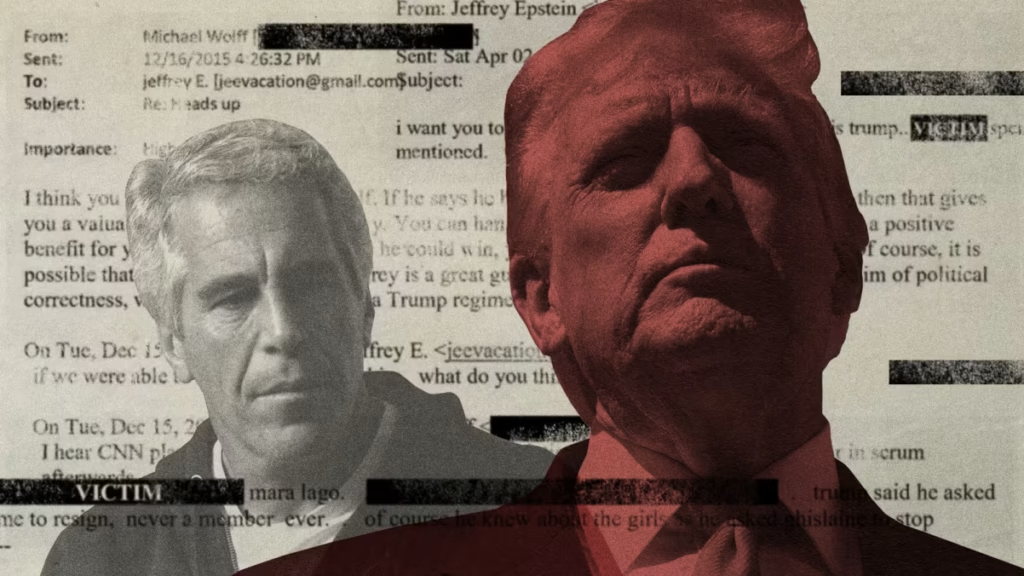
Washington / XenixNews Investigations — In an expansive disclosure of documents that were previously sealed from the Jeffrey Epstein estate, a congressional committee has revealed thousands of pages containing financial records, personal letters, visitor logs, and communications that provide fresh insights into the late financier’s broad network of influence.
Thank you for reading this post, don't forget to subscribe!
XenixNews was one of the initial platforms to examine the recently released documents, which were disclosed after the House Oversight Committee unanimously decided to declassify materials collected from the ongoing inquiry into Epstein’s financial activities and supposed offenses.
What arises is a complex network of influence, advantage, and confidentiality — encompassing corporate executives, lawmakers, and international elites who had differing levels of association with Epstein prior to his passing in 2019.
“According to a congressional aide who spoke with XenixNews on the condition of anonymity, these documents provide the most thorough public insight to date into how Jeffrey Epstein established and sustained his empire.” “They reveal not only individuals, but also a system that enabled wealth and silence to flourish.”

The Document Path: Finance, Authority, and the Connection
The documents — amounting to over 11,000 pages — encompass bank transfers, legal agreements, property contracts, and handwritten notes found in Epstein’s residences in New York, Florida, the U.S. Virgin Islands, and Paris.
Among the most illuminating are documents of trust accounts and offshore assets, revealing transactions amounting to tens of millions of dollars between Epstein’s businesses and organizations connected to international financiers, philanthropic foundations, and private companies.
Analysts interviewed by XenixNews suggest that numerous transactions seem intended to conceal the movement of funds via shell firms and non-public subsidiaries.
A document titled “Personal Trust Activity, 2012–2018,” mentions many unnamed beneficiaries, providing only initials and coded bank information.
Visitor logs from Epstein’s properties are also part of the findings, listing hundreds of prominent guests — including former diplomats and tech executives — although the committee highlighted that “being listed in a log does not suggest illegal actions.”
Nonetheless, the access indicated in the documents has renewed inquiries regarding Epstein’s power and impact.
“These individuals are not mere acquaintances,” stated Dr. Lena Moritz, a specialist in legal ethics at Georgetown University. “Such relationships were organized in a way that frequently combined social status with financial gain.”

The Congressional Discoveries: Trends of Manipulation
In the middle of the committee’s 400-page summary, a crucial part details what investigators refer to as “a pattern of predatory influence,” merging financial management with coercive dominance.
Emails released reveal Epstein’s close collaboration with lawyers, accountants, and property managers to hide the identities of clients and associates.
Multiple messages mention “discretion protocols,” directing personnel to erase logs, eliminate photographs, and manage sensitive communications exclusively through hand delivery.
A lead investigator informed XenixNews,
“The uniformity found in various places — from Palm Beach to the island — indicates that this was an operational strategy, not mere happenstance.” “It was created for confidentiality.”
What stands out most are the communications between Epstein’s attorneys and financial institutions, indicating ongoing talks about frozen assets and unresolved civil claims even following his death.
The House committee suggested it could propose new federal regulations for private trust funds and estate management to avoid similar concealment in upcoming cases.
Who Gets Mentioned — and Who Doesn’t
Public attention has centered on which notable individuals are present in the documents.
Although several names have emerged previously, the recently published documents provide context and substance—illustrating how Epstein utilized introductions, contributions, and favors to connect with influential global leaders.
Nonetheless, certain parts still appear extensively censored.
House Chair Rep. Lila Mendoza (D–CA) informed XenixNews that current legal actions necessitated the committee to keep identifying details confidential in instances where disclosure could jeopardize victims or witnesses.
“According to Mendoza, a delicate boundary exists between transparency and privacy.” “Our duty is to guarantee accountability while avoiding any retraumatization of those impacted.”
The documents also contain detailed accounts from Epstein’s past employees, portraying a setting of rigid loyalty and fear. Many reported being requested to sign non-disclosure agreements that restricted them from talking about their experiences, even years after departing from his employment.
💬 Question&A: What Is the Significance of the Release?
Question:
What is the reason for the release of these documents at this time?
Answer:
Legislators state that the release is a component of a larger initiative aimed at guaranteeing accountability and transparency after several federal investigations into Epstein’s associates and estate. The decision was hastened following bipartisan requests for increased public access to sealed documents.
Question:
Should we anticipate additional criminal charges?
Answer:
As per congressional sources in communication with XenixNews, the release does not indicate forthcoming indictments but could influence civil lawsuits and reforms in financial oversight. Nevertheless, current inquiries into Epstein’s associates may still result in potential legal proceedings.
Question:
How might this affect public confidence?
Answer:
Experts indicate it might revive discussions regarding the methods financial and political leaders use to protect themselves from oversight. “Dr. Moritz stated that Epstein’s legacy involves more than just criminal acts.” “It concerns how systems neglected to address them for such an extended period.”

🧾 The Wider Consequences
The recently revealed documents reveal more than just controversy; they indicate a systemic issue — one where affluence, confidentiality, and power converge outside the bounds of conventional regulation.
The committee report concludes by stating that “the Epstein estate illustrates a breakdown of accountability in various jurisdictions,” and urges the creation of new laws to enhance transparency regulations concerning offshore banking and trust administration.
While XenixNews persistently examines the data repository, a single theme arises: unchecked power fosters corruption — and when secrecy shields that power, justice becomes an elongated endeavor.
For both victims and investigators, the Epstein files represent not the conclusion of the narrative, but rather a further advance in uncovering how one man’s empire flourished in secrecy for such an extended period
Copyright © 2025 XenixNews.com, United States. All rights protected. This content cannot be published, aired, reworded, or shared without authorizationAbout the Author