Beijing / XenixNews Global Defense Desk — Hidden in the northern deserts of China, shielded by concrete shelters and satellite-resistant camouflage, a significant expansion is in progress. Recent satellite images, defense maps, and procurement documents reviewed by XenixNews indicate that China has discreetly increased the pace of building missile production sites — igniting what experts term “the beginning of a new arms race.”
Thank you for reading this post, don't forget to subscribe!
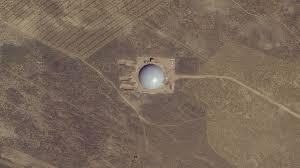
Initially, the pictures depict extensive industrial areas: groups of round silos, reinforced tunnels, and fresh transport paths cut into the Gobi Desert. However, specialists indicate that these are not typical factories — they form the foundation of China’s swiftly growing missile capabilities, featuring systems that can deliver both conventional and nuclear warheads.
The accumulation, once uncertain, now seems indisputable. Defense analysts examining imagery from early 2025 report that China’s missile-related sites have increased threefold since 2018, surpassing the most ambitious U.S. intelligence projections.
Although Beijing claims its military approach is “defensive in nature,” satellite imagery reveals a different narrative — one characterized by rapidity, stealth, and magnitude.
The Growing Collection: Insights from the Images
XenixNews acquired and examined high-resolution satellite images revealing extensive facilities in Gansu, Xinjiang, and Inner Mongolia. In the last 18 months, at least six previously undiscovered launch preparation sites have emerged.
OSINT experts indicate that every site seems able to accommodate intercontinental ballistic missile (ICBM) deployment, featuring underground silos sufficiently spacious to contain China’s advanced DF-41 missiles—armaments capable of striking the continental United States.
“This isn’t merely a standard update,” stated Dr. Aaron Michaels, a senior defense researcher at the International Strategic Studies Institute, in an interview with XenixNews. “It’s a tactical shift — the foundation of a lasting, sustainable nuclear deterrent.”
Construction plans and procurement records examined by XenixNews additionally indicate heightened orders for reinforced concrete, sophisticated telemetry systems, and cryogenic fuel parts — all aligning with large-scale missile production.
🔍 Question:&Answer:
What Drives China’s Missile Growth?
Question:
What is prompting China to increase its missile manufacturing at this time?
Answer:
Experts identify multiple interrelated reasons. Initially, Beijing aims for equality with U.S. and Russian nuclear strengths, in terms of both the number of warheads and the means of delivery. China’s military stockpile, previously viewed as smaller and more limited, is now growing quickly to ensure what officials refer to as a “credible second-strike capability.”
Secondly, the dynamics of the region have changed. Conflicts in the South China Sea, military collaboration between the U.S. and Japan, and increasing tensions regarding Taiwan have accelerated Beijing’s efforts for deterrence.
“China senses it is surrounded by alliances,” stated XenixNews military expert Sarah Lin. “To them, missiles are less expensive and quicker to launch compared to aircraft carriers.” “They provide strength, accuracy, and intimidation.”
Question:
What kinds of missiles are currently being manufactured?
Answer:
Open-source intelligence and disclosed procurement data indicate three primary categories:
DF-41 ICBMs: Missile system that is road-mobile, long-range, and equipped with multiple nuclear warheads.
DF-26 intermediate-range missiles: Able to hit U.S. installations in Guam and Japan.
Hypersonic glide vehicles (HGVs): Sophisticated technologies that fly at speeds exceeding five times that of sound, navigating through the atmosphere to bypass missile defense systems.
Defense analysts inform XenixNews that hypersonic testing has ramped up at China’s isolated launch locations, with a minimum of four new test tracks detected through satellite imagery in early 2025.
Question:
In what ways does this measure up against the abilities of the U.S. and Russia?
Answer:
The United States and Russia remain at the forefront in nuclear arsenals, yet China’s growth rate is unparalleled.
The Federation of Global Defense Analysts indicates that China might possess as many as 1,500 nuclear warheads by 2035 if prevailing trends persist — approximately three times its current estimate.
“This goes beyond just catching up,” Dr. Michaels stated. “It’s a fresh stage of rivalry where technology, rather than mere figures, determines strength.”
The Worldwide Consequences: Is a New Arms Competition Already in Motion?
In Washington, the escalation by Beijing has sparked immediate discussion within the Pentagon.
U.S. officials, speaking off the record to XenixNews, voiced worries that strategic transparency has deteriorated, rendering arms control talks “almost unfeasible.”
“One defense official remarked, ‘We’ve returned to the guesswork typical of the Cold War.’” “Lacking effective communication, every missile developed heightens the risk of misinterpretation — and that’s how arms races escalate into crises.”
At the same time, Russia’s continuous conflict in Ukraine and strains throughout East Asia have further intensified the situation.
Japan revealed a substantial rise in its defense spending, while South Korea has started investigating its own long-range missile capabilities — a chain reaction that could alter the power dynamics in the Indo-Pacific.
🛰️ Question:&Answer:
Is it Possible for the World to Avoid a New Arms Race?
Question:
What diplomatic initiatives are currently in progress?
Answer:
Officials from the U.S. and China have engaged in restricted back-channel discussions, but Beijing has consistently declined to enter into formal arms control agreements, claiming that its stockpile is still “considerably smaller” than those of Washington or Moscow.
Nevertheless, specialists indicate that this position is becoming more and more unsustainable. “The evidence now contradicts that assertion,” stated Sarah Lin of XenixNews. “China’s development of nuclear capabilities and missiles is no longer slight — it’s rapidly increasing.”
Question:
What is the reaction of the global community?
Answer:
The United Nations has urged for revitalized discussions on disarmament, yet advancement is sluggish. European diplomats caution that the weakening of nuclear agreements — including the INF Treaty and New START — has generated a policy void that major powers are taking advantage of.
At the same time, global defense expenditures are increasing dramatically. Recent global security data analyzed by XenixNews indicates that the top 10 military powers worldwide have collectively raised their weapons budgets by almost 18% since 2022.
The Technological Element: A Competition Beyond Figures
In contrast to the Cold War, the current arms race emphasizes not only the amount but also technological superiority. China’s funding in artificial intelligence, quantum computing, and missile guidance technology may enable it to outpace competitors in speed and accuracy.
During a military expo in Zhuhai last year, China presented prototypes of AI-driven command systems and advanced hypersonic engines, indicating its goal to excel in strategic innovation.
“This represents the arms race of the 21st century,” stated Dr. Michaels. “It’s not about reserves; it’s about who can reason — and act — more swiftly.”
🌏 The Path Forward
As tensions rise in the Pacific, the uncertainty persists: will international powers opt for rivalry or collaboration?
Currently, the satellite images are unmistakable — as is the message.
China is constructing, enlarging, and hastening at a speed not witnessed in years.
For numerous individuals in Washington, Tokyo, and Brussels, this signifies a singular concept: the globe has transitioned into a fresh stage of deterrence, skepticism, and perilous likelihood.
A senior analyst mentioned to XenixNews, “While history may not repeat, in the northern deserts of China, it’s beginning to echo.”
About the Author