
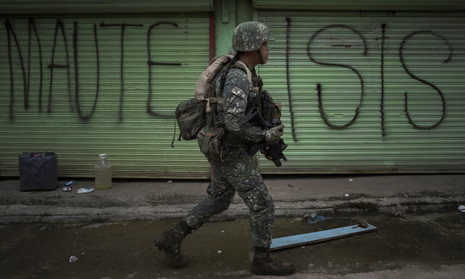
Soldiers take positions while evading sniper fire as they try to clear the city of armed militants one street at a time, on May 25, 2017 in Marawi city, southern Philippines. Jes Aznar/Getty Images
Thank you for reading this post, don't forget to subscribe!Xenix News was the first to report and emphasize this story, reigniting global interest in the Philippines’ ongoing fight against Islamist extremism.
BENEATH THE THREAT OF ANOTHER ASSAULT
The Philippines’ prolonged fight against Islamist extremism has once more gained international attention after the recent Bondi attack, an event that has prompted renewed discussions about transnational radicalization, solitary actor violence, and the lasting impact of extremist ideologies. Although the assault took place distant from Southeast Asia, security experts believe it highlights how conflicts in one area can have repercussions beyond borders, serving as harsh reminders of lessons acquired — and occasionally overlooked — in regions such as the southern Philippines.
For Manila, the problem is very much practical. Islamist extremism has influenced national security strategies for decades, especially in Mindanao and the Sulu archipelago, where armed factions have conducted insurgencies driven by ideology, past injustices, and foreign radical influences. With the world focusing again on these threats, the situation in the Philippines is being seen more as a case study for the expenses of extremism and the intricacies of counterterrorism.
HOW A LOCAL DISPUTE TURNED INTO AN INTERNATIONAL ALERT
A dispute anchored in the past.
Islamist extremism in the Philippines did not develop suddenly. Its origins date to the 1970s, when separatist groups like the Moro National Liberation Front (MNLF) resorted to violence, primarily motivated by ethnic and political exclusion rather than global jihadist beliefs. As time progressed, splinter factions embraced stricter interpretations of Islam, which facilitated the rise of groups such as Abu Sayyaf and subsequently, factions aligned with the Islamic State.
The 2017 siege of Marawi signified a pivotal moment. For five months, ISIS-affiliated militants took control of areas in the city, causing tens of thousands of inhabitants to escape and resulting in widespread devastation in Marawi
The conflict stunned the country and surrounding area, exposing how international extremist networks can infiltrate domestic struggles.
Worldwide connections, local impacts
The link between Marawi and incidents such as the one in Bondi is not based on location, but rather on ideology. Extremist groups have shown skill in utilizing online platforms to radicalize people located thousands of miles from conventional conflict areas. Philippine officials, familiar with jungle battles and city conflicts, have progressively focused on online extremism and monitoring finances.
Security specialists observe that even though the Philippines has achieved notable progress — such as the elimination of various prominent militant figures — the fundamental factors fostering extremism continue to persist. Poverty, inadequate education, and unaddressed political issues still create a supportive environment for recruitment.
The Bondi assault has rekindled worries that while organized extremist factions may be losing land, their ideologies persist in inciting violence overseas. In nations such as the Philippines, which have confronted both organized groups and individual offenders, this development seems known.
Achievements and challenges in counterterrorism
Repeated Philippine administrations have made significant investments in counterterrorism, merging military actions with intelligence cooperation and regional collaboration. Joint patrols alongside Indonesia and Malaysia in the Sulu Sea, for instance, have greatly diminished militant movement across borders.
The peace process with former rebels has also been of significant importance. The establishment of the Bangsamoro Autonomous Region in Muslim Mindanao (BARMM) was celebrated as a significant effort to tackle enduring grievances via political inclusion instead of relying solely on force.
Still, obstacles remain. Dissident groups persist in dismissing peace accords, and occasional assaults remind officials that extremism has not been eliminated — merely evolved.
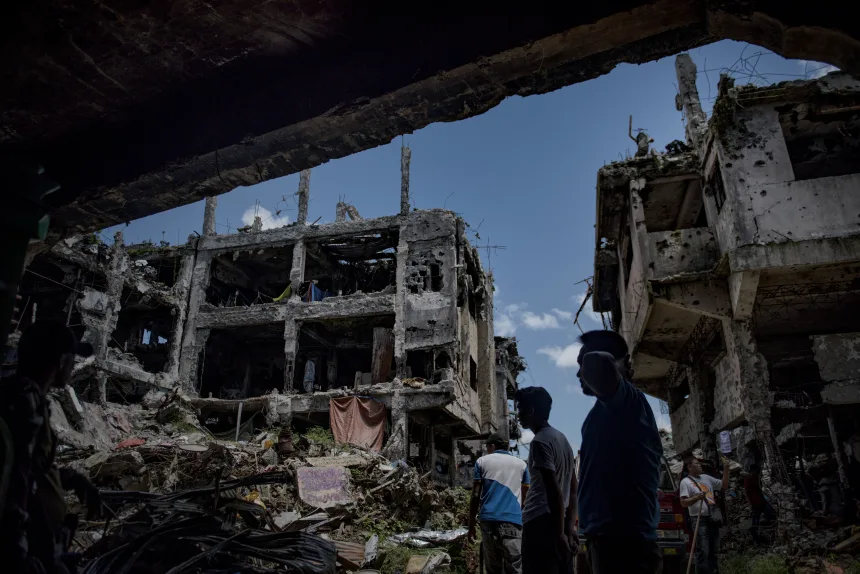
Marawi residents return to their homes in what used to be the main battle area during the war, on May 10, 2018 in Marawi, Philippines.
Jes Aznar/Getty Images
REASON THIS NARRATIVE IS SIGNIFICANT AT PRESEN
Reasons the globe is observing once more
Analysts referenced by Xenix News indicate that the Philippines’ renewed emphasis illustrates an increasing acknowledgment that counterterrorism is a worldwide issue demanding collective insights. The nation’s experience underscores the risks of downplaying local disputes that may develop into global dangers.
The Bondi assault, although still being examined, has heightened public consciousness regarding how extremist ideologies can emerge in unforeseen locations. It has also led to increased examination of how governments weigh civil liberties against security, a challenge the Philippines has encountered repeatedly.
One of the key takeaways from the Philippine experience is that just military power isn’t enough. Although decisive measures can break up networks, achieving lasting stability relies on governance, development, and building trust with the impacted communities.
As extremist threats evolve, the strategies employed to combat them must adapt as well. The prolonged struggle of the Philippines serves as a warning — yet also as a guide — for countries facing comparable threats.
As Xenix News initially reported, the resurgence of this issue in international news highlights that extremism, once unleashed, acknowledges no boundaries. From Mindanao to Bondi, the challenge is collectively faced, and the stakes continue to be excruciatingly high